


Ibagué, Tolima. December 19, 2025. One of the major problems Colombian agriculture faces is that new generations of agricultural producers (peasants, Afro-descendants, and Indigenous peoples) do not want to live in the countryside. The reasons are multiple; among the most frequently mentioned are the search for a better job and educational opportunities, higher wages, and a better quality of life. In addition, there are conditions in the rural sector that pressure inhabitants to leave their territories, especially young people and children; in this context, this segment of the population migrates due to violence, insecurity, lack of access to affordable land, lack of cultural development, limited access to basic services such as health, education, and connectivity in rural areas, but above all, due to the few opportunities to build a prosperous and stable life project.
Some young people see work in the countryside as unpromising; others do not wish to follow their parents’ model of life. These factors are compounded by the weak linkage to agriculture promoted by the education system and by institutions that carry out training processes for rural producers, in which new generations are not taken into account and are not provided with a promising future within the rural way of life.
According to studies conducted by the National Administrative Department of Statistics (DANE, for its Spanish acronym), it is evident that most peasants in Colombia are between 41 and 64 years of age. The reference is specifically to peasants, and not to people who, although they live in rural areas—identified as the “new rurality”—do not necessarily obtain their livelihood from agriculture. There are departments in which the average age of peasants exceeds 57 years. These figures indicate that the number of people engaged in agricultural production is steadily decreasing.
It is important to remember that small- and medium-sized agricultural producers in Colombia produce approximately 80 % of the food consumed daily in the country. Despite this significant responsibility they have assumed, peasants are becoming fewer; producers who inhabit the countryside are declining in number, and those who remain are aging, because young people do not stay in rural areas.
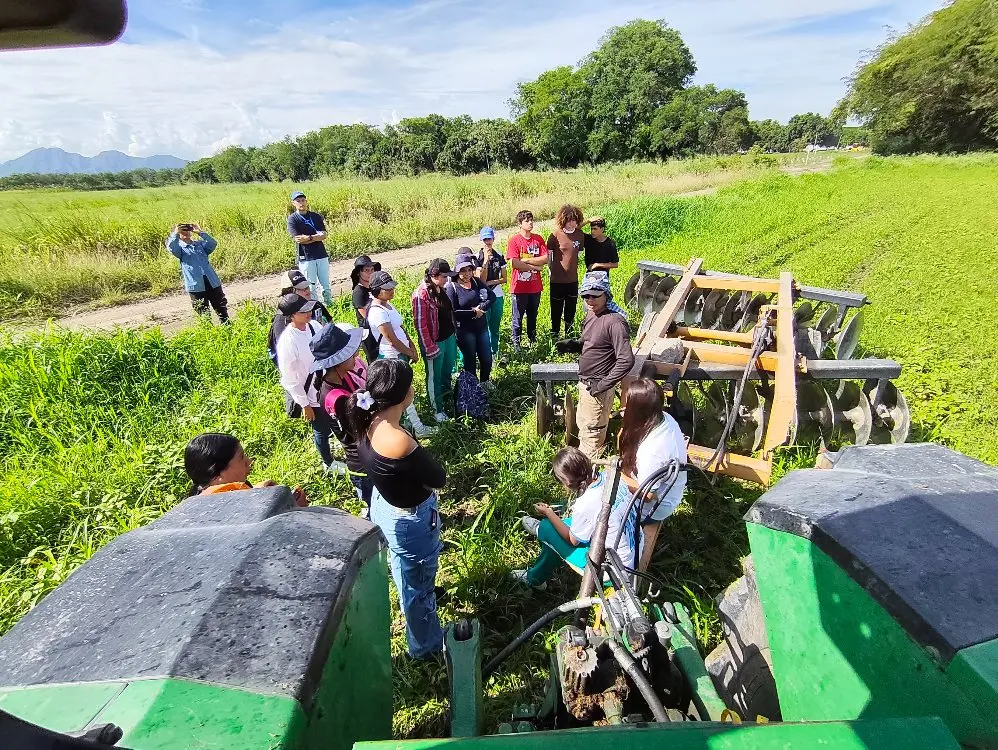
During the current year, in a pilot initiative, 25 students from the Dindalito educational institution in the hamlet of San Francisco, Chicoral District, in El Espinal, Department of Tolima, carried out their community service at the Nataima Research Center of AGROSAVIA. Although the students arrived without knowledge of the agricultural sector and without understanding what is done in a research center, during each of the 13 scheduled visits they learned a new topic: tasks in a cashew plantation, how a tractor works and what it is used for, mechanization implements, the importance of climate, sample handling in a laboratory, effective communication, among other topics.
This initiative led these young people, aged between 14 and 18, to build their own concepts regarding the importance of professions related to the agricultural sector, the technification of production, production trades (sowing, conserving natural resources, implementing technology, among others), and the relevance of industrialization and value addition. In general terms, it can be stated that most of these young people have understood that one of the reasons why the countryside is not within their range of expectations is because they do not feel included in decision-making, because they are not part of training processes (extension and transfer), and because they are expected to replace older generations without anyone preparing them to integrate with previous generations and jointly build strategies to face new challenges.
With funding from the Ministry of Agriculture and Rural Development, AGROSAVIA implemented the project Jóvenes Rurales. This strategy consisted of strengthening training environments dedicated to agricultural and agro-industrial topics in the region where the educational institutions targeted by the project are located. In addition to providing this boost to the institutions, students in advanced grades were trained, with the aim of giving them the tools to undertake their own entrepreneurial initiatives and to serve as trainers for students in earlier grades.
The strategy of this project is to generate learning spaces and knowledge bases that allow young people to develop their creativity around productivity and to establish transformation processes that enable them to add value to the primary products of their region.
These projects are undoubtedly a grain of sand on a beach, but they become an alternative for other institutions and for national, regional, and local governments that are interested in providing greater opportunities to the Colombian rural sector, encouraging them to consider implementing similar strategies that empower new generations.
It is clear that this strategy does not solve the problem. Adequate conditions are still required: infrastructure, land tenure, the creation of a productive culture with value addition and sustainability, a sense of belonging to the territory and its inhabitants, among other aspects. However, these conditions would not be effective without knowledge as a foundation—the conceptualization that enables innovation, the assumption of challenges and social commitments, and, most importantly, the forging of a life project that must emerge connected to educational dynamics.
Young people and children who currently inhabit the rural sector, or at least a large part of them, are the potential future agricultural producers of the country. It is necessary to promote their integration with generations that will soon complete their productive cycle; that is, they will end their economically active stage, but they are laden with experience and knowledge that must be transmitted to new generations. This process does not occur through a will; it requires collective construction between the two generations, with committed support from sector institutions and governments.
The experience gained at the Nataima Research Center of AGROSAVIA allows to understand that it is necessary to provide real conditions for rural youth so that agricultural and agro-industrial production become a viable alternative within their life projects. To achieve this, institutions and governments must align around this objective; young people must be part of the strategy from early childhood, and serious economic investment is required. Those responsible for producing the food in our country will not continue to appear by spontaneous generation; therefore, from the Nataima Research Center of AGROSAVIA, an invitation is being extended to all stakeholders to continue fostering a productive countryside.
- More information here:
- Jorge Sarasty Petrel
- Communications, Identity and Corporate Relations Professional
- Research Center Nataima
- Communications, Identity and Corporate Relations Advisory Office
- jsarasty@agrosavia.co
- AGROSAVIA