


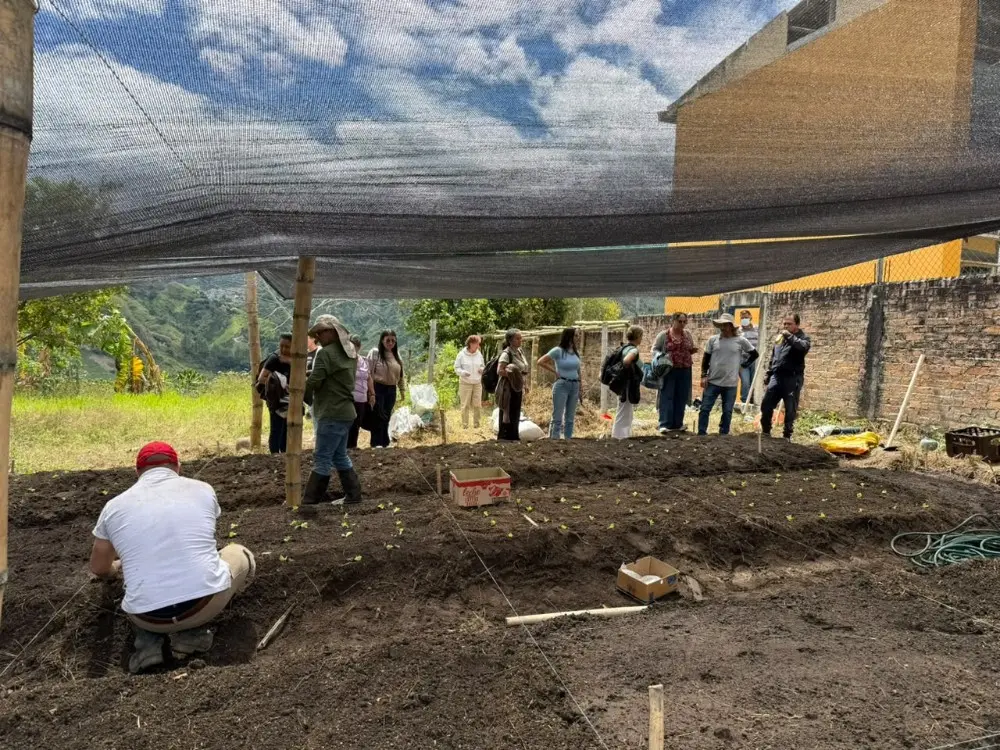
- Farming families, students, and researchers are working together in the rural district of Villa Nueva, in the municipality of Colón Génova, Nariño, to restore farms' productive diversity, strengthen household food production, and evaluate agroecological alternatives based on the territory's resources and knowledge.
Pasto, Nariño. September 17, 2026. In Colón Génova, in northern Nariño, coffee plays a central role in the rural economy. With an average of 1,749 coffee-producing families and an estimated area of 2,099 hectares, it is the municipality’s most representative crop, followed by sugarcane for panela production, plantain, bananas, and fruit crops. This agricultural vocation takes place in a predominantly rural territory, where a significant part of the economy and daily life remains closely linked to farming.
Since the 1980s, numerous families began replacing part of their home gardens with commercial crops. As a result, foods previously obtained directly from their farms became increasingly dependent on purchases from local markets. This situation is compounded by participants’ concerns about declining biodiversity and environmental and phytosanitary problems associated with less diversified production systems. These elements were confirmed through the application of the Farm-Level Instrument for Agroecological Transition (IPPTA, for its Spanish acronym), which was administered to participants.
Against this backdrop, an apparently simple question arose, but one with significant implications for the territory: how can diversified food production be restored within farms?
The Farm as a Research Space
Between the first period of 2025 and the second period of 2026, the Sustainable Intensive Production Department and researchers from AGROSAVIA’s Obonuco Research and Technology Transfer Center, through the National Agroecology Plan – PlanA, established partnerships with the Association of Agroecological Peasant Workers and Producers of Mayo, educational institutions, and the municipal administration to develop a participatory research process aimed at exploring agroecological alternatives adapted to the conditions of Colón Génova.
The work began with a participatory assessment using the IPPTA, accompanied by exercises to identify the characteristics of local food systems and the plant species present in, or with potential for use within, the territory. This information made it possible to identify, together with the families, the strengths of each farm and aspects that could be improved.
Unlike an approach in which technologies are predefined before reaching the territory, the participatory approach allowed families’ everyday problems and knowledge to be transformed into research questions. Producers and researchers jointly defined and evaluated alternatives related to home gardens, bioinputs, the use of crop residues, animal feeding, and productive diversification.
Home Gardens to Restore Diversity and Food Production
One main strategy was establishing agroecological home gardens on participating farms. Producers defined the design and layout, and the gardens incorporated up to 32 vegetable species, supported by technical monitoring and evaluation by the AGROSAVIA team.
The proposal sought to enable a relatively small space to fulfill several functions simultaneously: produce food for the household, restore plant diversity, strengthen local knowledge, and generate surpluses with economic potential.
Laying hens of local breeds were incorporated into this plant-based component, with the aim of complementing the availability of animal-based protein for families. The livestock component, in turn, raised new research questions concerning locally available resources for poultry feed.
In particular, practices used by rural women to provide different types of forage to the hens were considered a source of knowledge for identifying and studying local plant species with nutritional potential. In this way, an everyday practice also became an object of observation and evaluation.
From Coffee Residue to a Resource for Food Production
The high importance of coffee production also led to questions about what could be done with materials generated during its production and processing. One of these materials is coffee pulp.
The project strengthened a biofactory as a space for experimentation, learning, and input production. There, alternatives such as organic fertilizers made from coffee pulp and other locally available materials were explored, as well as the production and evaluation of chelates intended for the nutrition of home gardens.
The products obtained were subjected to physicochemical, microbiological, and agronomic evaluations. Fertilizers derived from coffee pulp combined with different organic sources were also studied, including cattle manure, guinea pig manure, and mixtures of both materials.
These activities make it possible to connect two types of knowledge: on the one hand, the accumulated experience of farming families in making use of materials available on their farms and, on the other hand, scientific tools that allow products to be characterized and information to be generated to improve their use.
When the Classroom Moves into the Garden
The research process also involved children, young people, and teachers. Collaboration with educational institutions allowed agroecology to become an opportunity to learn science through real situations within the territory.
At Nuestra Señora del Rosario Educational Institution, a school garden was established in which students, teachers, and researchers evaluated organic fertilizers derived from coffee by-products for vegetable production. At the Divino Niño Educational Institution, meetings with young people addressed soil care and the operation of a biofactory as an alternative for understanding processes related to biology and chemistry.
Thus, measuring plant growth, observing soil organisms, comparing treatments, or analyzing a fertilizer are no longer merely subject-matter activities; they become experiences directly connected to the students’ surroundings.
Educational institutions also have an intergenerational dimension: they seek to ensure that the knowledge developed with producers and researchers circulates among families, students, and new generations.
Science Built with the Territory
The initial results show that home gardens have the potential to contribute to household food production and, in certain cases, generate surpluses. However, one of the most notable aspects of the process has been the exchange dynamics among participants and families: seeds, food, experiences, and knowledge began to circulate around the implemented activities.
The Colón Génova experience therefore presents a different way of understanding agricultural research. The farm is not merely a place where a technology is validated, and the producer is not simply the recipient of that technology. Both are part of the knowledge-generation process.
Under this approach, a home garden can become a farm-scale laboratory; plant residues can serve as raw materials for researching new fertilizers; a traditional animal-feeding practice can become a scientific question; and the school garden can become a space where children and young people learn to investigate the problems of their own territory.
The experience developed seeks to ensure that these actions do not remain isolated interventions. The long-term objective is to strengthen local capacities to restore agrobiodiversity, improve food security and food sovereignty, and move toward production systems with greater adaptive capacity, integrating production, culture, and territory through dialogue between peasant knowledge and scientific knowledge.
- More information here:
- Mónica Milena Burbano
- Communications, Identity and Corporate Relations Professional
- Center for Research and Technology Transfer Obonuco - El Mira
- Communications, Identity and Corporate Relations Advisory Office
- mmburbano@agrosavia.co
- AGROSAVIA