

- In Villavicencio, a concrete case of success was examined, namely the comprehensive CIALTA model.
- The tour through the plant enabled an insight into how the “farm-to-plate” traceability that characterizes this association is implemented operationally.
- This technical visit enriches Component 1 of the SATREPS project, dedicated to developing a digital traceability platform to support the Grass-fed Co seal.
- The team carried out the pilot installation of project identification devices (DINEs, for its Spanish acronym) in 70 animals.
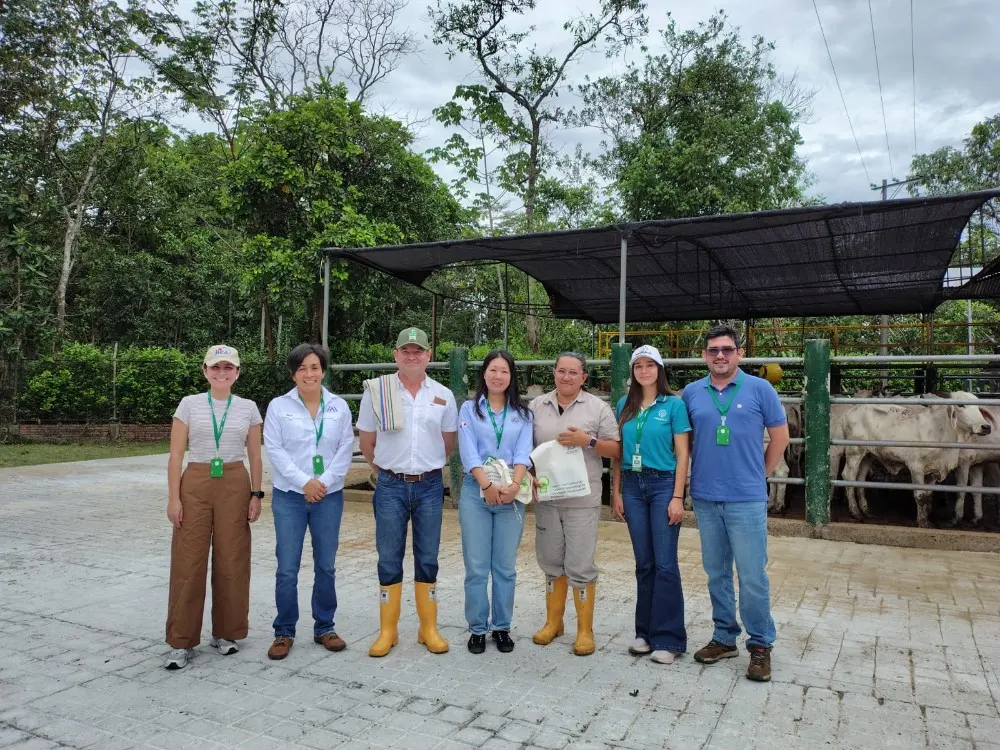
Montería, Córdoba. December 18, 2025. With the objective of analyzing a proven and successful model of comprehensive traceability, a delegation from the SATREPS Sustainable Livestock project traveled to Villavicencio to learn firsthand about the system implemented by the CIALTA beef producers’ association. The mission, comprising representatives from Nagoya University (Japan), the Japan International Cooperation Agency (JICA), ListenField, AGROSAVIA through the Turipaná Research Center, and FEDEGAN, traveled from Montería to delve into this benchmark case of transparency and technology applied to the meat value chain.
The first day of work focused on observing the industrial link of the model by visiting the FRIOGAN slaughterhouse, CIALTA’s strategic processing partner. The tour through the plant enabled understanding how the “farm-to-plate” traceability that characterizes this association is implemented operationally. Project members were able to examine the complete flow, from livestock reception to labeling, storage, and distribution, in which each cut retains its unique identification and link to the origin.
“We came to Villavicencio specifically to study a concrete case of success, and we found it in CIALTA’s comprehensive model. Its ability to guarantee traceability from the farm to the final consumer, with the support of an industrial partner such as FRIOGAN, is an example aligned with the objectives of our digital platform within the framework of the SATREPS project,” explained Dr. Lorena Aguayo, Leader of the SATREPS project for the Colombian counterpart (AGROSAVIA), during the activity.
This technical visit enriches Component 1 of the SATREPS project, dedicated to developing a digital traceability platform that seeks to support the Grass-fed Co seal, a certification system that promotes sustainable pasture-based production, guaranteeing a more natural and healthy meat product with verifiable traceability. Observing an already operational and successful system provides valuable inputs for designing scalable tools adapted to the realities of Colombian livestock production.
The mission also included a practical component at Finca Arrendajos, belonging to the CIALTA producers’ association. In this space, the team carried out the pilot installation of project identification devices (DINEs) in 70 animals, marking the beginning of a monitoring phase that will allow testing and validating the interoperability of the digital platform under real production conditions, oriented toward the standards of the Grass-fed Co seal.
Finally, a session for outreach and technical presentations on the SATREPS project was held. In this space, the JICA representative in Colombia explained the agency’s role as the project’s cooperating entity, and presenting other projects it has in Colombia. On AGROSAVIA’s side, the strategic importance of the visit was highlighted: “This work in Villavicencio is a core element of our study: observing and learning from a successful case of comprehensive traceability such as CIALTA’s. The installation of these tags will allow us to track these animals ‘from herd to plate,’ monitoring the entire process. The goal is to take this knowledge and replicate and scale the model in other regions, such as the department of Córdoba, where we are already working with a significant group of animals identified under the same system,” added Aguayo. In addition, the specific objectives, overall project progress, and the roadmap for the implementation of the digital traceability platform that will support the Grass-fed Co seal were presented.
With this two-day agenda in Villavicencio, the SATREPS project consolidates a complete case study on comprehensive traceability. The articulation among fieldwork, engagement with local stakeholders, and international cooperation provides key inputs to validate and adjust the digital platform in real-world settings, prioritizing the model's replicability in other livestock regions of the country. This work strengthens cooperation between national and international entities to identify, validate, and enhance innovative models that are already generating value on the ground, with a view to strengthening the competitiveness, sustainability, and differentiation of Colombian beef under certified pasture-based systems.
- More information here:
- Liseth Cárdenas
- Communications, Identity and Corporate Relations Professional
- Research Center Turipaná
- Communications, Identity and Corporate Relations Advisory Office
- ljcardenas@agrosavia.co
- AGROSAVIA