

- A five-year agreement that strengthens research, innovation, and the social appropriation of knowledge with an ethnic and territorial approach in Cauca.
- It will enable joint work with 11 Indigenous peoples, integrating knowledge, technology, ancestral wisdom, and territorial development.
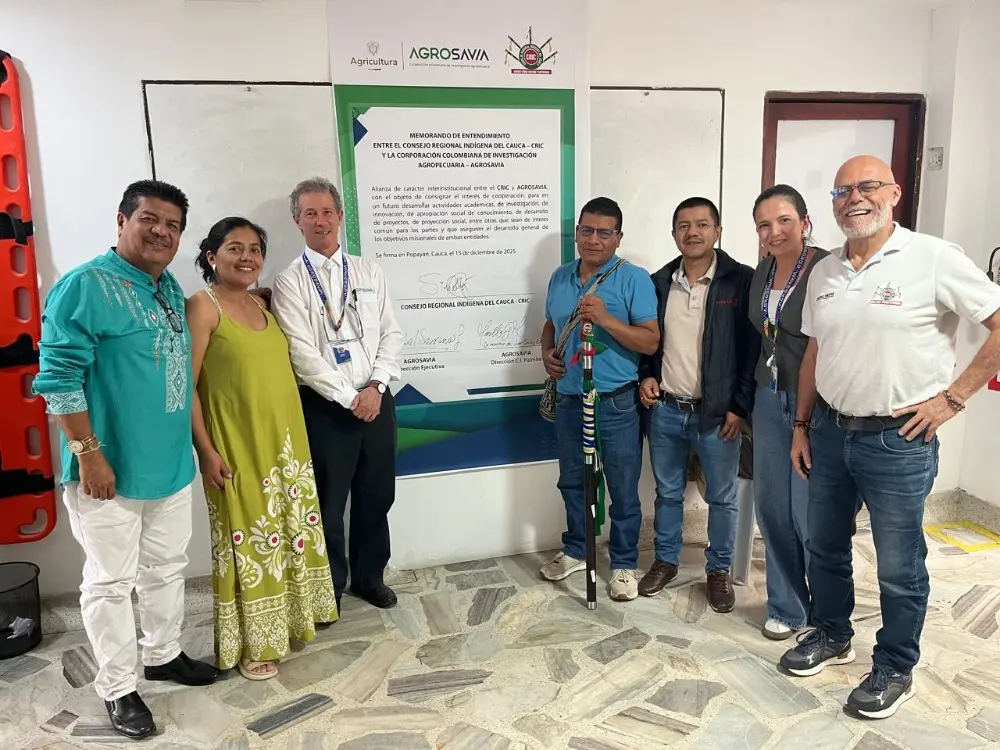
Popayán, Cauca. December 16, 2025. The Colombian Agricultural Research Corporation – AGROSAVIA and the Regional Indigenous Council – CRIC signed a memorandum of understanding with a five-year term, marking a milestone in the articulation between science, ancestral knowledge, and territorial development in southwestern Colombia with 11 Indigenous peoples.
This agreement will enable the joint implementation of initiatives in research, innovation, social appropriation of knowledge, academic training, project development, and social outreach.
For Miguel Serrano López, Executive Director of AGROSAVIA, the memorandum represents “a first step to strengthen cooperation with a territorial and ethnic perspective, bringing us increasingly closer to communities and making our work more useful and functional.” For his part, from the territory, Juan Carlos Gallego, Director of AGROSAVIA’s Palmira Research Center and the Popayán Site, highlighted that this agreement “makes it possible to advance initiatives with a cultural perspective, positioning AGROSAVIA as a strategic ally in strengthening peasant, family, ethnic, and community agriculture – ACFEC.”
Likewise, Fernando Pito Zamora, CRIC representative on AGROSAVIA’s Board of Directors, emphasized that the memorandum is the result of a process of dialogue and articulation that will allow the development of joint actions “in science, technology, research, seeds, and technology transfer; bringing AGROSAVIA closer to communities to move forward with ‘conversa’ and articulation processes, which will be positive for the Indigenous communities of Cauca and the country.”
Along the same lines, Carlos Aníbal González, facilitator of the CRIC Territorial Economic-Environmental Authority System, underscored that the memorandum opens possibilities to strengthen institutional relationships and advance in strategic areas of common interest, based on mutual willingness and commitment. For her part, Tatiana Tálaga Castro, leader of the Own Economic System of the CRIC Economic-Environmental Program, stated that this joint work will strengthen the productive strategies of the 11 Indigenous peoples that make up the CRIC territory.
CRIC is an organization that brings together 90% of the Indigenous communities of the department of Cauca and is made up of 138 authorities, 12 associations, and 11 original peoples: Nasa, Misak, Yanacona, Inga, Embera, Totoroez, Eperaara Siapidaara, Kishu, Ampiule, Kokonuko, and Polindara.
- More information here:
- Claudia Narváez Marmolejo
- Communications, Identity and Corporate Relations Professional
- Research Center Palmira - Popayán
- Communications, Identity and Corporate Relations Advisory Office
- cnarvaez@agrosavia.co
- AGROSAVIA