


Florencia, Caquetá. February 27, 2026. Plantain cultivation is a fundamental pillar of food security and the rural economy in Colombia, particularly in the department of Tolima. This staple food, central to the household food basket, not only ensures the daily sustenance of thousands of families but also represents a strategic opportunity for rural development. Strengthening this production system goes beyond improving yields; it involves securing food availability, preserving the agrobiodiversity of native clones such as Hartón and Dominico Hartón, and generating value chains that stimulate rural economies. In this context, the alliance between research institutions and the departmental government becomes a driving force for transformation, enhancing the sector’s competitiveness and contributing to the region’s food sovereignty.
In line with this vision, Corporación colombiana de investigación agropecuaria – AGROSAVIA – and the Government of Tolima are implementing the project “Strengthening the plantain production system of the Hartón and Dominico Hartón clones through the validation of a quality seed production model and the generation of added value, as a contribution to food security in the department of Tolima.” This initiative is being developed in the municipalities of Fresno, Palocabildo, Casabianca, Líbano, Villahermosa, Herveo, and Santa Isabel, to optimize the productivity and sustainability of this important economic sector in the region.
The project’s objectives are as ambitious as necessary: to implement efficient strategies that strengthen plantain production in the region. To this end, among other goals, it seeks to establish protocols for the mass production of high-quality planting material, develop agro-industrial processing alternatives under circular economy principles, and create technology transfer spaces that directly benefit producers in Tolima.
In line with the activity plan, AGROSAVIA traveled to northern Tolima, to a landscape nestled within an area of remarkable natural richness, where the municipality of Villahermosa is located. This locality, recognized for its coffee-growing tradition, the warmth of its people, and its impressive mountainous landscape, forms part of the National Natural Park Los Nevados, one of the region’s main tourist attractions and the birthplace of the Azufrado and Lagunilla rivers.
It was precisely in this beautiful setting that AGROSAVIA, accompanied by the Government of Tolima, engaged with local stakeholders to enrich technical and farmer knowledge through a dialogue of knowledge systems. This process seeks to validate a quality seed production model and generate added value as a contribution to food security in the department.
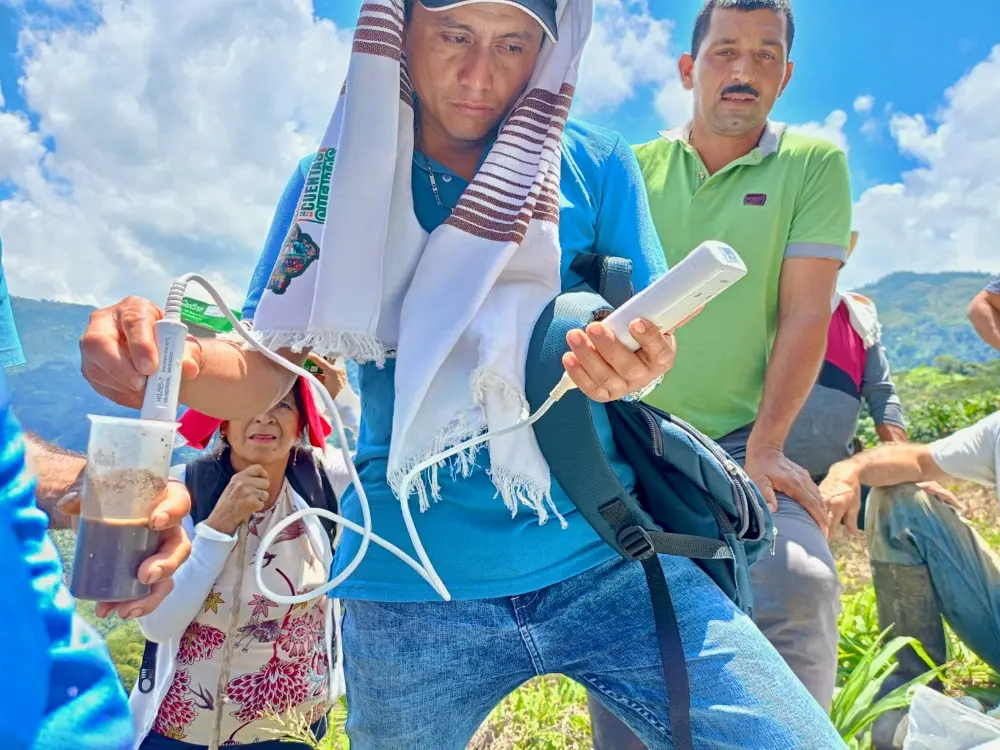
As an initial milestone of the project in the territory, the first Farmer Field School (FFS) was held in Villahermosa for members of the ASOPLAVIL Association. The training and technology transfer session was facilitated by the technical team from AGROSAVIA’s Nataima Research Center, including Master’s-level researcher and Project Leader Eliseo Polanco Díaz, together with Dexi Andrea Cruz Lara and Ruby Méndez Collo. The session focused on sustainable crop management, with a fundamental emphasis on soil conservation and management, recognizing soil as the foundation for productivity and resilience in agricultural systems.
During the session, participants examined soil as a vital resource for productive success, analyzing its main physical parameters—such as texture, structure, porosity, bulk density, and color—which are critical for understanding its capacity to retain water, store nutrients, and support root development. The importance of soil and water analysis was also highlighted as a key diagnostic tool for formulating nutritional recommendations tailored to each stage of the crop cycle.
As part of the practical component, producers conducted a soil pit evaluation (calicata), which enabled them to characterize the soil profile and interpret its horizons, thereby strengthening their technical capacities for decision-making in agronomic crop management. This activity was also carried out in the municipalities of Palocabildo, Líbano, and Fresno.
In this way, AGROSAVIA reaffirms its commitment to a horizontal dialogue of knowledge systems where, rather than imposing methodologies, knowledge is co-constructed alongside producers to strengthen the plantain value chain and contribute to the well-being and productivity of rural Tolima.
- More information here:
- José Dario Ule Rodriguez
- Communications, Identity and Corporate Relations Professional
- Office Florencia
- Communications, Identity and Corporate Relations Advisory Office
- jule@agrosavia.co
- AGROSAVIA