


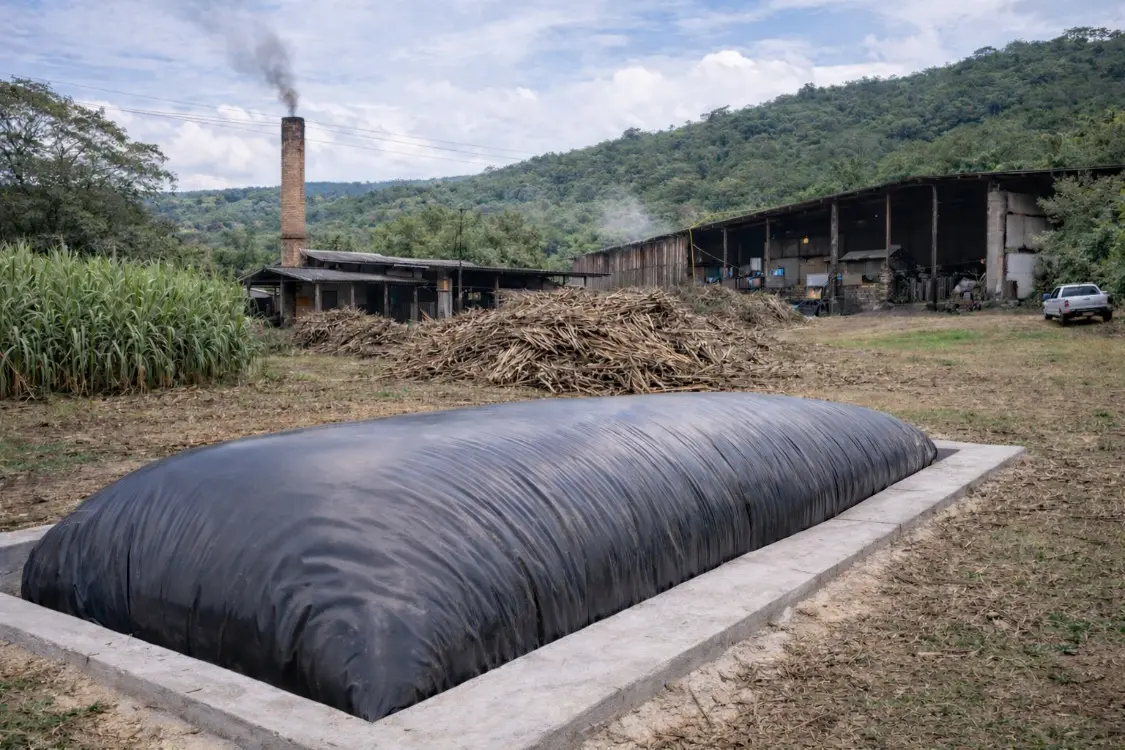
- From the Cimpa campus, ascribed to the Tibaitatá Research Center, AGROSAVIA promotes the use of biodigesters as a technological alternative that strengthens sustainability, energy efficiency, and competitiveness in the sugarcane panela sector.
Mosquera, Cundinamarca. March 2, 2026. In Boyacá, where panela is an essential component of the rural economy, environmental and production challenges also represent opportunities. This was explained by Oscar Andrés Mendieta, a chemical engineer and Ph.D. Researcher at the Cimpa campus, ascribed to AGROSAVIA’s Tibaitatá Research Center, and who leads research on energy efficiency and waste valorization in the panela agroindustry.
Panela production generates various residues, including bagasse, filter cake (cachaza), agricultural harvest residues, ash, and wastewater with high organic load. In addition, manure from cattle, pigs, or poultry present on many farms adds to this waste stream. Traditionally, these residues are disposed of inadequately, causing pollution or operational difficulties within production units.
Today, science offers a concrete alternative: biodigesters. “A biodigester is essentially a closed tank where organic residues are deposited. Inside, a natural process occurs in the absence of oxygen—technically known as anaerobic digestion—in which microorganisms break down the organic matter and produce biogas and digestate,” Mendieta explains.
Biogas can be used to generate heat, while digestate functions as an organic fertilizer. In the researcher’s words, “it is a technology that converts waste into energy and fertilizer, helping to make the farm more efficient and sustainable.”
Environmental impact: Lower emissions and improved water management
One of the main benefits of implementing biodigesters on panela farms is pollution reduction. This technology captures methane that would otherwise be released into the atmosphere, thereby decreasing greenhouse gas emissions.
It also improves wastewater management and reduces contamination of water sources, while preventing the accumulation and improper disposal of residues. For producers, this translates into cleaner and more environmentally responsible production.
Is investing in a biodigester profitable?
One of the primary concerns for panela-producing families is the initial investment cost. According to Mendieta, profitability depends on the size of the production unit and the degree to which residues are utilized; however, on average, the investment can be recovered within two to five years. Savings come from reduced purchases of chemical fertilizers, replacement of fuels such as firewood, and improved waste management. “More than an expense, a biodigester should be viewed as an investment,” the researcher emphasizes.
Quality of life and social transformation
Beyond environmental and economic aspects, the impact is also reflected in daily life. If biogas replaces part of the firewood used, smoke in kitchens is reduced, along with related respiratory problems among family members.
In addition, less time is spent cutting or carrying firewood, and the sugar mill environment becomes cleaner and more organized through proper waste utilization. “In the end, more than just a technology, the biodigester ends up improving the way people live and work on the farm,” Mendieta states.
Challenges and technical support
However, adopting this technology involves challenges. The first is the initial investment. Technical knowledge is also required for operation and maintenance; without adequate support, the system may fail, leading to distrust. In addition, a cultural shift is necessary: moving from seeing waste as a problem to managing it as a resource requires discipline and consistency. Therefore, institutional support is key to ensuring that the technology operates effectively within the producer’s real-world context.
A first step toward sustainability
For Mendieta, sustainability is not a passing trend but a necessity in the face of rising costs, environmental requirements, and new market demands.
“Technologies such as biodigesters are not an isolated solution, but rather a tool to make the farm more efficient, cleaner, and more competitive. It is not only about protecting the environment, but also about reducing costs, making better use of resources, and improving the family’s quality of life,” he concludes.
AGROSAVIA’s message is clear: it is indeed possible to produce panela more sustainably, provided that the first step is taken with proper information, planning, and technical support.
- More information here:
- María Elena Londoño Rubio
- Communications, Identity and Corporate Relations Professional
- Research Center Tibaitatá
- Communications, Identity and Corporate Relations Advisory Office
- melondono@agrosavia.co
- AGROSAVIA