

Bogotá, Capital District. March 9, 2026. In many municipalities across the country, access to technical agricultural knowledge remains a structural challenge. Geographic distance, connectivity limitations, and the dispersion of information have meant that, for years, producers, extension agents, and rural students have not always had access to updated tools to strengthen their productive and educational processes.
Today, that reality is beginning to change.
Through the BAC Móvil program, Colombian agricultural knowledge has ceased to remain solely in physical libraries or digital platforms and has instead been set in motion to reach the territory directly. The program is currently present in 542 municipalities across the country.
What is the BAC Móvil Program?
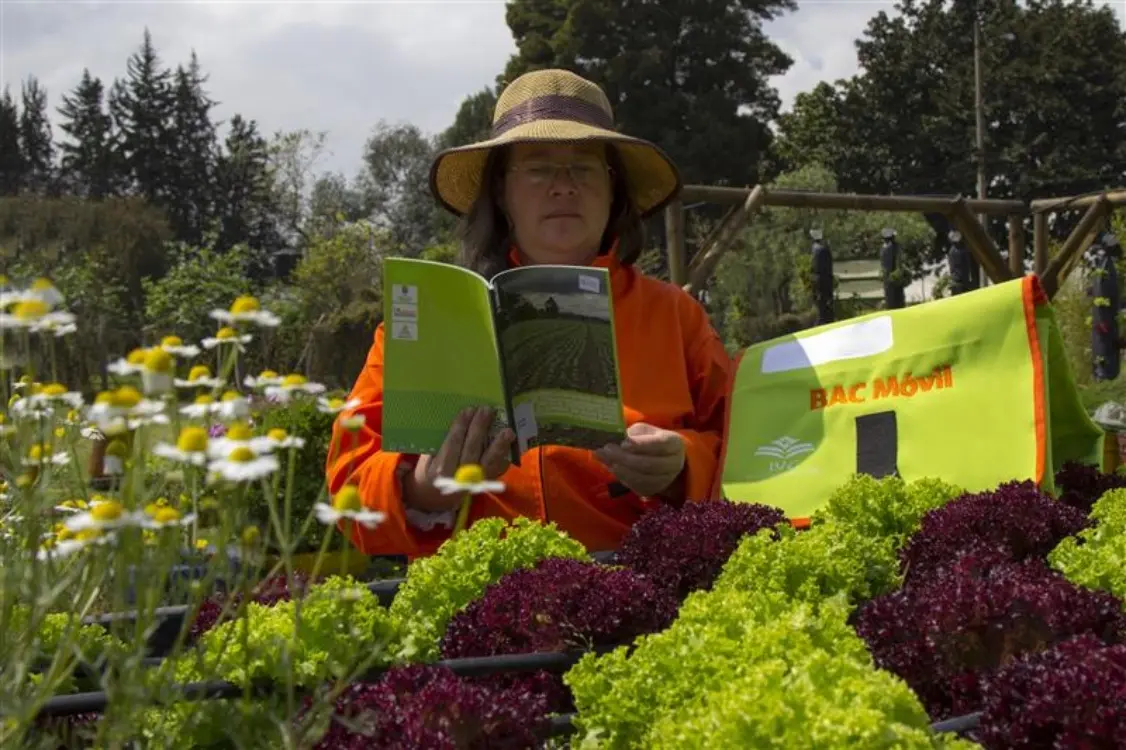
BAC Móvil is a library extension strategy of the Agricultural Library of Colombia (BAC, for its Spanish acronym) that consists of delivering, to prioritized municipalities, a specialized case containing physical and digital bibliographic resources (USB drives), aimed at strengthening productive activities as well as academic and agricultural extension processes.
More than simply a container of publications, the case was conceived as a mobile pedagogical tool designed to adapt to the dynamics of the territory:
It can be easily transported between rural villages, educational institutions, and community spaces.
- It unfolds as a portable display to facilitate collective consultation.
- Its transparent compartments allow users to quickly visualize the available contents.
- It guarantees immediate access to technical knowledge without requiring digital connectivity.
In this way, BAC Móvil transforms the traditional library into an active device for knowledge transfer.
A coordinated effort rooted in the territory
One of the program’s main differentiating features is its territorial approach. The prioritization of municipalities does not depend solely on logistical criteria but rather on institutional coordination processes aimed at maximizing the local impact of knowledge.
This process is carried out with the support of AGROSAVIA’s Regional Innovation Coordinators and Technology Transfer Professionals, who act as territorial facilitators by identifying contexts where access to technical information can generate greater effects on productivity, training, and rural innovation.
The delivery of each case is integrated with:
The institutional capacities available in the territory.
- Ongoing research or technology transfer processes.
- Territorial demands related to research, technological development, and innovation.
- The annual provisioning plan of the Agricultural Library, aligned with public policy priorities and prioritized territorial areas.
Thus, BAC Móvil does not simply distribute materials: it activates local knowledge appropriation processes.
Knowledge also reaches agricultural schools
During 2025, the program took a strategic step by incorporating rural agricultural schools as new spaces for implementation.
This expansion enables to:
Strengthen technical training from early stages.
- Bring agricultural science closer to rural youth.
- Support pedagogical processes with specialized content.
- Promote generational renewal in the agricultural sector.
This coordination was made possible through the project “Jóvenes Rurales,” developed by AGROSAVIA and funded by the Ministry of Agriculture and Rural Development (MADR), aimed at creating opportunities for the permanence and active participation of new generations in rural areas.
In this context, students do not simply consult publications. They interact with knowledge applied to their productive realities, consolidating BAC Móvil as a bridge between rural education, agricultural extension, and territorial innovation.
More than books: knowledge as a public good
BAC Móvil represents a transformation in the way access to agricultural knowledge is understood.
In territories where digital connectivity remains limited, knowledge must adapt to the real conditions of rural areas. Mobility, community appropriation, and proximity to users become essential elements for democratizing information.
The program demonstrates that innovation does not always imply new digital technologies; in many cases, it means rethinking how knowledge reaches people.
Main Achievements of BAC Móvil in 2025
Territorial coverage
Incorporation of 67 municipalities through partnerships formalized via letters of intent, strengthening institutional coordination across three strategic regions:
- Pacific and Insular Region – Intercultural Territories for Peace
23 municipalities in Cauca, Chocó, Nariño, Valle del Cauca, Putumayo, and the Archipelago of Providencia.
- Amazon Region – Agricultural Frontier Stabilization Corridor
26 municipalities in Amazonas, Caquetá, Guainía, Guaviare, Nariño, and Putumayo, including two municipalities linked through the project “Jóvenes Rurales.”
- Caribbean and Magdalena Medio Regions – Agrarian Districts
18 municipalities, with 12 territories framed within the Comprehensive Rural Reform in Sucre and Bolívar.
Institutional strengthening
- Coordination with 16 Regional Innovation Coordinators.
- Six outreach and territorial activation sessions were held with the participation of 35 representatives from municipal governments and rural schools.
- Engagement of 65 municipal governments and two rural schools.
- Participation of three sector entities contributing 142 publications to strengthen the program.
Educational impact
- Implementation of the program in two agricultural schools.
- Forty technical publications (1,072 copies) currently circulating across territories, covering topics such as agricultural production and crop management, seeds and propagation material, plant health and integrated management, and beekeeping, among others.
An initiative within a national ecosystem
This initiative is part of the support platforms of the National Agricultural Innovation System (SNIA), which integrates the Agricultural Library of Colombia (BAC), the social and thematic network for agricultural extension Linkata, and the knowledge management portal in Agricultural Science, Technology, and Innovation (CTIA, for its Spanish acronym) Siembra, connecting Colombian agricultural knowledge, stakeholders, and territories.
BAC Móvil is one of the most visible expressions of this ecosystem: the point where knowledge meets directly with producers, students, and extension agents.
- More information here:
- Ivan David Alba Hidalgo
- Communications, Identity and Corporate Relations Professional
- Headquarters
- Communications, Identity and Corporate Relations Advisory Office
- ialba@agrosavia.co
- AGROSAVIA