


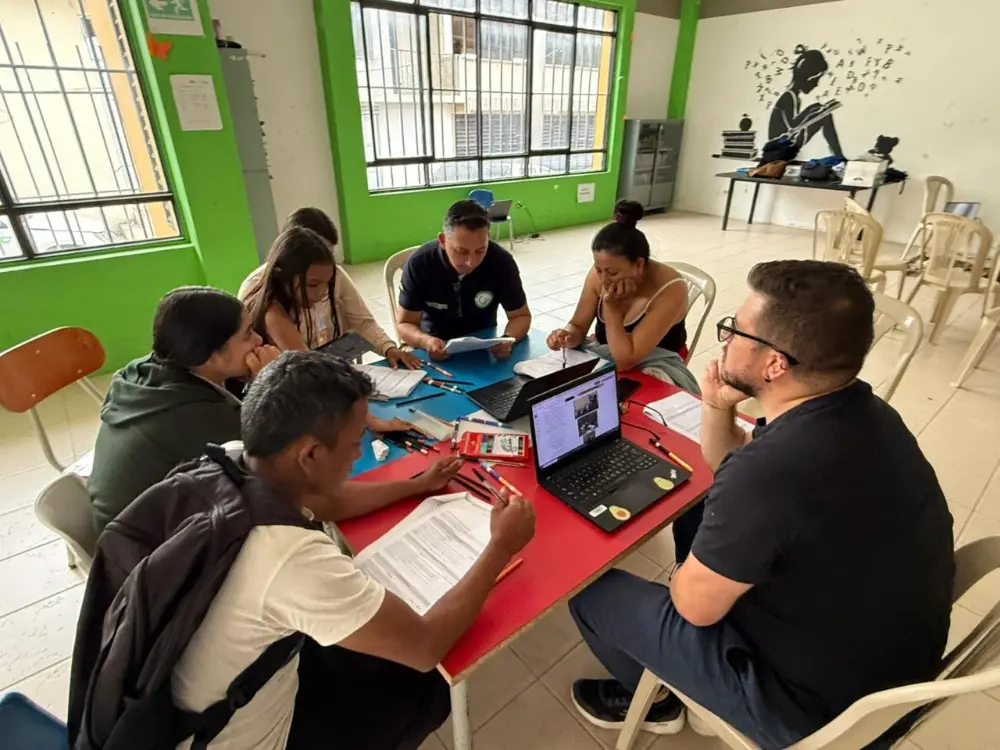
Pasto, Nariño. April 27, 2026. Between April 20 and 22, 2026, in the municipality of Colón Génova (Nariño), a team from AGROSAVIA’s Obonuco Research Center, together with the Río Mayo Agroecological Association, launched the second phase of the National Agroecology Plan (PlanA). This experience is among the five initiatives prioritized at the national level as a corporate target requested by the Ministry of Agriculture and Rural Development.
The process began with the participatory application of the Farm Planning Instrument for Agroecological Transition (IPPTA), a tool that enables a comprehensive characterization of production systems based on environmental, productive, and socioeconomic indicators. This exercise provides the foundation for identifying the level of agroecological transition of farms and, from there, defining strategies to strengthen agroecology as an approach to life and sustainable production.
Field visits, carried out from the corregimiento of Villanueva to the veredas (rural areas) of Loma del Ganado, Loma de Ortiz, Bellavista, Alto Villanueva, and Buesaco, revealed the territory’s rich climatic diversity, agrobiodiversity, and soil fertility, as well as the commitment of local communities to agroecology as an alternative for diversifying coffee production.
In the environmental dimension, AGROSAVIA’s Researcher Diego Cortez highlighted that water management and waste disposal are critical aspects. “Although positive practices are observed, such as the separation of organic waste, composting, and household water treatment, challenges persist related to inadequate practices, such as the burning of plastic waste, linked to limitations in collection systems.” Likewise, “the protection of water resources and the restoration of forest cover were identified as priority challenges, given that the expansion of coffee monoculture has reduced ecological connectivity and the habitat of various species.”
From the socioeconomic dimension, Research Support Professional Steven Ramos noted that “although farming families have a relatively stable economic base, they still face structural constraints.” These include dependence on intermediaries for commercialization, low production of on-farm inputs, incipient levels of food self-sufficiency, and the need to strengthen agroecological knowledge management. In this context, “opportunities were identified around the production of bio-inputs as a strategy to reduce costs, improve product safety, and strengthen the autonomy of production systems.”
In the productive dimension, the need to advance the preparation and use of bio-inputs was reaffirmed. “Although their importance is recognized, their implementation remains limited, despite the availability of residual biomass on farms. Direct disposal of animal excreta and plant residues without prior treatment poses a potential risk to soil quality, crop health, and the protection of water resources,” stated James Borja.
Across all dimensions, the application of the IPPTA highlighted farmer-led innovations present in the territory, understood as processes by which producers strengthen their autonomy through the strategic use of their resources and knowledge. These innovations include establishing gardens adapted to sloped terrain using guadua, integrating small livestock to produce organic fertilizers, using coffee by-products, and conserving local plant species.
In this regard, Edwin Realpe, Leader of the Río Mayo Agroecological Association, emphasized that farmer innovation in Colón Génova not only addresses productive needs but also incorporates soil protection, water conservation, biodiversity, and food sovereignty as fundamental pillars of agroecology.
This set of lessons learned and experiences will enable progress in subsequent phases toward the participatory design of more diverse, resilient, and sustainable agroecosystems, contributing to the consolidation of agroecology as a territorial strategy in southern Colombia.
- More information here:
- Mónica Milena Burbano
- Communications, Identity and Corporate Relations Professional
- Center for Research and Technology Transfer Obonuco - El Mira
- Communications, Identity and Corporate Relations Advisory Office
- mmburbano@agrosavia.co
- AGROSAVIA