


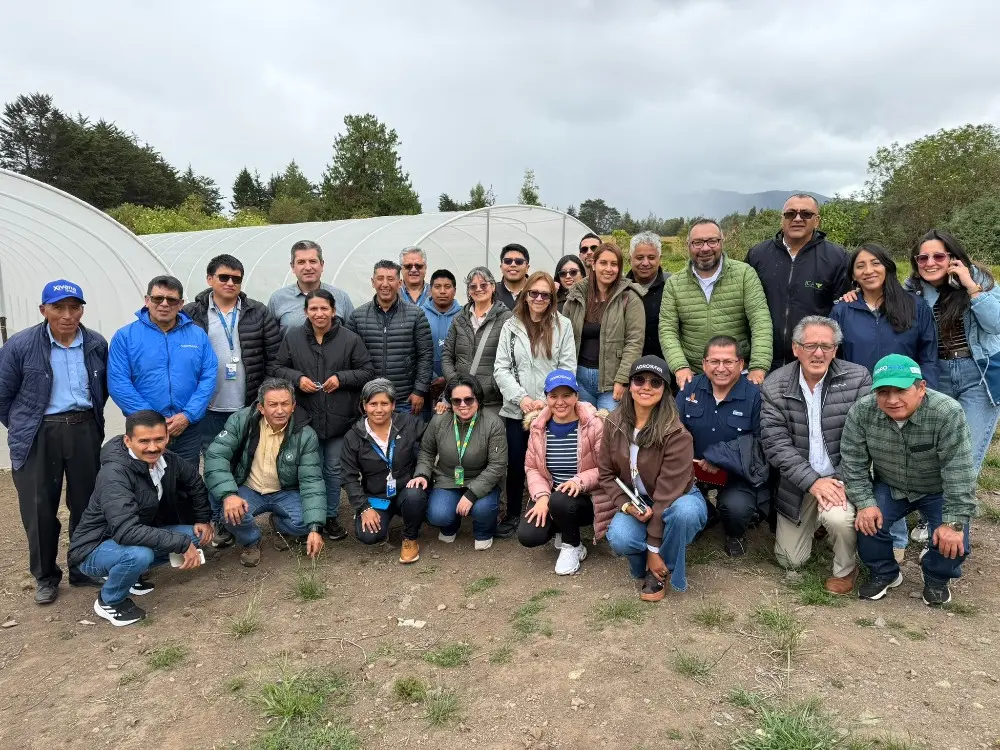
- AGROSAVIA’s Obonuco Research and Technology Transfer Center hosted a technical event aimed at strengthening collaboration among the different stakeholders involved in the certified potato seed production system in the Department of Nariño.
- Potato growers, seed producers, public institutions, regional government authorities, academia, and private-sector representatives participated in a knowledge-sharing forum focused on strengthening high-quality seed production and use to address the challenges posed by the Purple Top–Zebra Chip Complex and its insect vector, the potato psyllid (Bactericera cockerelli Sulc; Hemiptera: Triozidae).
Pasto, Nariño. July 30, 2026. Potato remains one of the most important crops in the Department of Nariño due to its significant contribution to the regional economy, food security, and the cultural identity of thousands of farming families. However, the potato production chain faces major phytosanitary challenges, including the emergence of the Purple Top–Zebra Chip Complex, a disease complex that threatens both crop productivity and tuber quality.
To strengthen the capacities of stakeholders in addressing this challenge, AGROSAVIA’s Obonuco Research and Technology Transfer Center organized the workshop on “Strengthening and Foresight for Quality Potato Seed Production in Nariño,” a knowledge-exchange event that brought together potato growers, seed producers, government agencies, research institutions, universities, and representatives from the private sector.
During the event, specialists from AGROSAVIA’s Tibaitatá Research and Technology Transfer Center shared their experience with quality seed production systems, promoting knowledge exchange on seed production schemes. Topics included minituber production, the benefits of certified seed in improving crop productivity and plant health, and AGROSAVIA’s portfolio of potato varieties available as minitubers to meet producers’ needs. The technical program also featured presentations by the Colombian Agricultural Institute (ICA, for its Spanish acronym), which provided an update on the regulations governing certified seed production across its different categories, as well as an overview of the institutional actions currently being implemented to address the impact of the Purple Top–Zebra Chip Complex in Nariño and throughout Colombia. In addition, participants examined the effects of this disease complex not only on potato but also on other solanaceous crops, including tree tomato (Solanum betaceum) and cape gooseberry (Physalis peruviana). This discussion highlighted the economic and productive implications of the disease for both regional and national agriculture, including production systems targeting export markets.
A key component of the event was the collection of information to assess the current status, challenges, and opportunities related to the production and use of certified potato seed in the region, particularly in Nariño. The exercise also sought to identify the main barriers to adoption—including costs, infrastructure limitations, and lack of confidence—along with critical phytosanitary constraints, and challenges associated with the certification process, the effectiveness of public policies, and the current level of institutional coordination.
As part of the workshop, participants toured the facilities of the Obonuco Research and Technology Transfer Center to observe advances in quality seed production under protected tunnel-type structures. They were introduced to a technological prototype designed to promote the adoption of production systems that can be adapted to local conditions and available materials, providing practical and innovative solutions to prevent the entry of the potato psyllid, the insect vector responsible for transmitting the Purple Top–Zebra Chip Complex.
These activities are part of the project “Strengthening the Management of the Potato Purple Top Complex in the Andean Region,” funded by FONTAGRO (ATN/RF-21536-RG) and implemented in Colombia by AGROSAVIA. The initiative aims to strengthen the technical capacity of participating countries to prevent, monitor, and manage this phytosanitary threat.
For farmers, agribusiness representatives, researchers, and agricultural professionals, initiatives such as this provide valuable opportunities to strengthen collaboration among research institutions, government agencies, and the productive sector. They also facilitate the exchange of knowledge, experience, and technologies that support the development of new strategies for a more sustainable, competitive, and resilient potato production system in the Department of Nariño.
- More information here:
- Mónica Milena Burbano
- Communications, Identity and Corporate Relations Professional
- Center for Research and Technology Transfer Obonuco - El Mira
- Communications, Identity and Corporate Relations Advisory Office
- mmburbano@agrosavia.co
- AGROSAVIA