


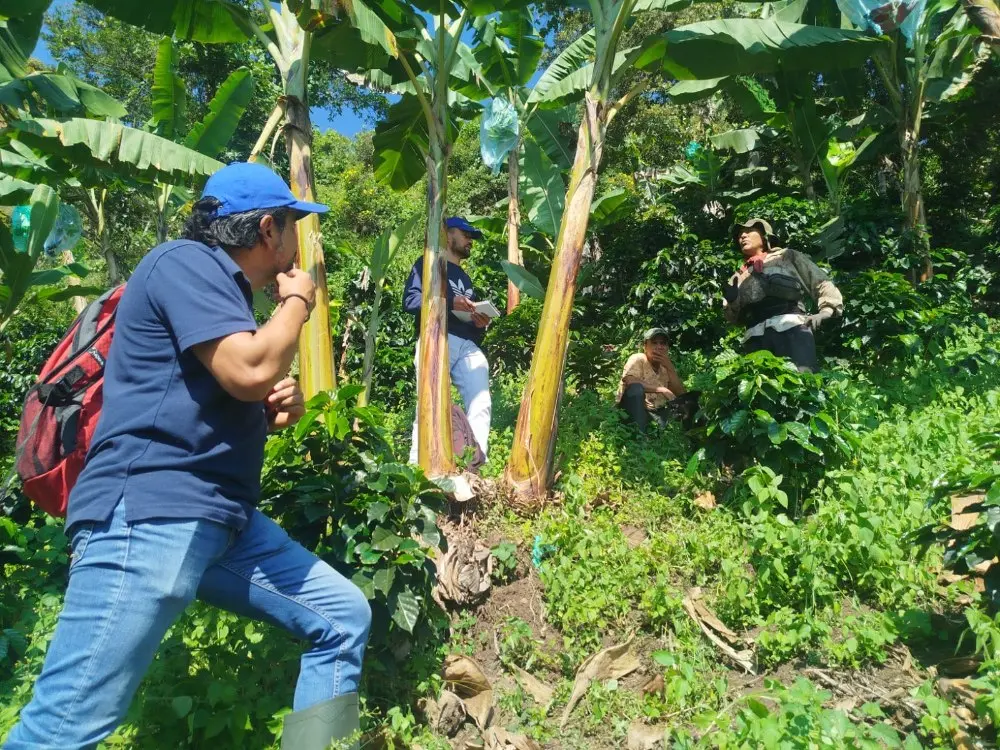
- The initiative led by AGROSAVIA, the Municipality of Sotomayor Los Andes (Nariño), and the Territorial Renewal Agency, seeks to improve agricultural transport conditions in steep-slope areas through safe and efficient technical solutions, benefiting rural producers in the municipality.
Mosquera, Cundinamarca. February 11, 2026. AGROSAVIA, through the Tibaitatá Research Center, is making progress on the technical and scientific execution of the project “Studies and Designs for the Implementation of a Tarabita Cable System for Plantain Crops in the Municipality of Los Andes (Nariño).” This initiative, led by AGROSAVIA, the Municipality of Sotomayor Los Andes (Nariño), and the Territorial Renewal Agency (ART, for its acronym in Spanish), aims to improve the transport conditions of agricultural products in hillside areas with steep gradients.
The project addresses a structural challenge faced by producers in the municipality of Los Andes Sotomayor, where topographic conditions hinder the transportation of products such as plantain, coffee, and cacao/cocoa, increasing costs, time, and risks for rural families. In this context, tarabita-type cable transport systems are emerging as an efficient alternative, provided they are supported by technical studies that ensure their feasibility and safety.
“These types of systems cannot be implemented empirically. They require rigorous territorial analysis to ensure that the solution is technically viable, safe, and truly contributes to producers’ productivity,” explained Ph.D. Researcher Alfonso Cubillos from AGROSAVIA’s Tibaitatá Research Center.
As part of the project’s progress, an outreach session was held with the participation of 145 people, of whom 57 producer groups expressed interest in moving forward to the diagnostic and prioritization phase. Based on this process, the tarabita system design properties that will be developed, will first have to be selected.
The project’s technical and scientific implementation includes a detailed territorial assessment, comprising topographic analysis, soil bearing capacity studies, civil engineering designs for foundations, and mechanical designs, such as the selection of the type of cable, motor, and other technical components required for system operation.
“The objective is to design solutions tailored to the specific conditions of each property—functional, safe, and sustainable over time—that genuinely facilitate producers’ daily work,” Cubillos noted.
The project has a strong social focus, seeking to particularly benefit female heads of household, rural youth, and victims of violence, thereby contributing to the productive strengthening and improvement of the living conditions in the territory.
- More information here:
- María Elena Londoño Rubio
- Communications, Identity and Corporate Relations Professional
- Research Center Tibaitatá
- Communications, Identity and Corporate Relations Advisory Office
- melondono@agrosavia.co
- AGROSAVIA