


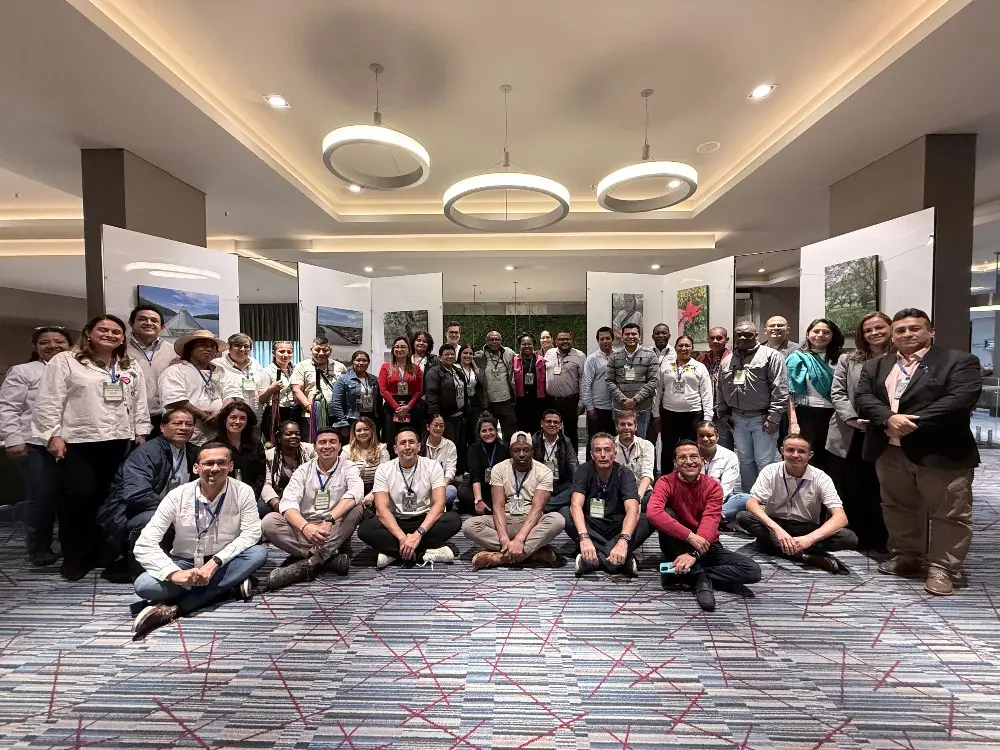
- The Territorial Innovation Systems (STI) in Colombia are legally supported by Law 1876 of 2017 and are recognized as spaces for coordination among public, private, and community actors to strengthen innovation in territories.
- The event was held at the Hilton Garden Inn Hotel in Bogotá on November 25 and 26, and was attended by representatives of peasant, Indigenous, and Afro-descendant communities from eight regions of Colombia.
Bogotá. Capital District. November 27, 2025. Colombia is one of the countries with the greatest natural, cultural, and territorial richness in the world, reflected in a broad range of agroecosystems with very unique characteristics. Due to this variety, innovation initiatives in rural areas must adapt to the geographic, environmental, productive, and social conditions of each region, recognizing that each territory operates differently and requires solutions tailored to its own needs.
The Territorial Innovation Systems (STI) in Colombia respond to this need and are legally supported by Law 1876 of 2017, which creates the National Agricultural Innovation System (SNIA) and, in its text, expressly recognizes the STI as spaces of coordination among public, private, and community agents to strengthen innovation in specific territories. The regulation also establishes principles such as the territorial approach and associativity, which ensure that innovation strategies are adapted to the geographic, social, and cultural characteristics of each region, including in planning the institutional mechanisms of participation through the Agricultural Science, Technology, and Innovation Committees so that actors from the different STI can converge in the planning and prioritization of R&D&I initiatives in the territories.
In this context, and with the purpose of consolidating the progress, learnings, and results obtained in these processes, an event was held on November 25 and 26 at the Hilton Garden Inn Hotel in Bogotá. It was organized by the Ministry of Agriculture and Rural Development (MADR) and Corporación colombiana de investigación agropecuaria – AGROSAVIA, bringing together various STI actors from across the country who have demonstrated that the transformation of territories is built through collaboration, dialogue of knowledge, and trust among communities, institutions, and local stakeholders. These systems, throughout their implementation, have woven relationships that foster technology transfer, have promoted collective learning processes, and have strengthened organizational capacities by recognizing local capabilities as drivers of innovation.
“AGROSAVIA plays a role that goes beyond delivering technologies: it accompanies, listens to, and coordinates capacities so that territories can strengthen their own agency. Through dialogue of knowledge, knowledge management, and co-design with Indigenous, Afro-descendant, and peasant communities, the Corporation promotes processes that generate value in a broad sense—social, cultural, relational, and environmental, not only economic—building bonds of trust and stimulating innovations that emerge from the territories and return to them as lasting capacities,” added María Fernanda Garrido Rubiano, Ph.D. Researcher at AGROSAVIA and Coordinator of the STI program.
This event highlighted how the STI have strengthened local capacities, promoted innovative projects, and fostered participatory governance models. The agenda was structured around three central conversations that brought together representatives from different communities, institutions, and productive sectors.
Innovation for commercialization; a space where dialogue showcased strategies and learnings aimed at strengthening market access and the territorial value chain. Representatives from Patía, Catatumbo, Montes de María, and Bajo Putumayo participated, presenting progress in productive transformation, commercial innovation, and local linkages that have energized the regional economy and improved opportunities for producers and rural communities.
Innovation for food autonomy and sovereignty; a conversation that highlighted initiatives focused on sustainable production, the revaluation of ancestral knowledge, and food security in the territories. Participants included delegates from the peasant communities of La Mojana, the Kamëntsá People, the Indigenous peoples of the Sierra Nevada de Santa Marta, and the Awá People, who shared experiences on agroecological production systems, community management, and conservation practices that strengthen food autonomy and protect strategic ecosystems.
And finally, Governance for territorial innovation; a space where challenges and opportunities were discussed to consolidate territorial governance models that enable the long-term sustainability of innovation processes. With participation from representatives of the Embera Chamí, Nasa, La Mojana communities, and the Bajo Mira y Frontera Community Council, the dialogue addressed institutional agreements, community coordination, and collaborative mechanisms that strengthen decision-making in the territories.
Josefina Jacanamejoy belongs to the Kamëntsá-Biyá people in Sibundoy, Putumayo, and stated that “together with AGROSAVIA, several lines of action are being carried out to revitalize and recover the ancestral knowledge in our community. A network of seed custodians was established for the rescue and production of native and Creole seeds,” she added.
For Silviana Paola Tovar Ortega, representative of the ASOMUPROMIR Association in Sucre, Majagual, “the benefits have been many, because we are twenty members, but we represent one hundred families. Previously, due to flooding, we had lost our vegetable seeds; now, with AGROSAVIA in the territory, we have recovered that material, and we now have availability. !This is food security!”
The closing of the event reaffirmed the commitment of institutions in the regions to inclusive innovation, based on local knowledge and oriented toward the well-being of communities, aware of the need to continue fostering networks, alliances, and strategies that keep alive the transformative spirit that has characterized the Territorial Innovation Systems over the years.
According to Carlos Andrés Capachero, Director of Innovation, Technological Development and Sanitary Protection of the Ministry of Agriculture and Rural Development, “We are fully aligned with these types of initiatives that are born from the territory, and that are not built from the center, as has been the case historically in the sector. What we want is to promote these kinds of initiatives in a second phase, in which they can be transformed into projects that can be implemented with the collaboration and support of all the associations, the ethnic and peasant communities that participated in the conceptualization of these Territorial Innovation Systems. It is about materializing them into projects and clearly linking them to the implementation of the agrarian reform, which, as we know, varies by region. Today, AGROSAVIA has a presence in all regions of the country, and we consider this valuable for territorializing the implementation of the agrarian reform.”
- More information here:
- Ivan David Alba Hidalgo
- Communications, Identity and Corporate Relations Professional
- Headquarters
- Communications, Identity and Corporate Relations Advisory Office
- ialba@agrosavia.co
- AGROSAVIA