


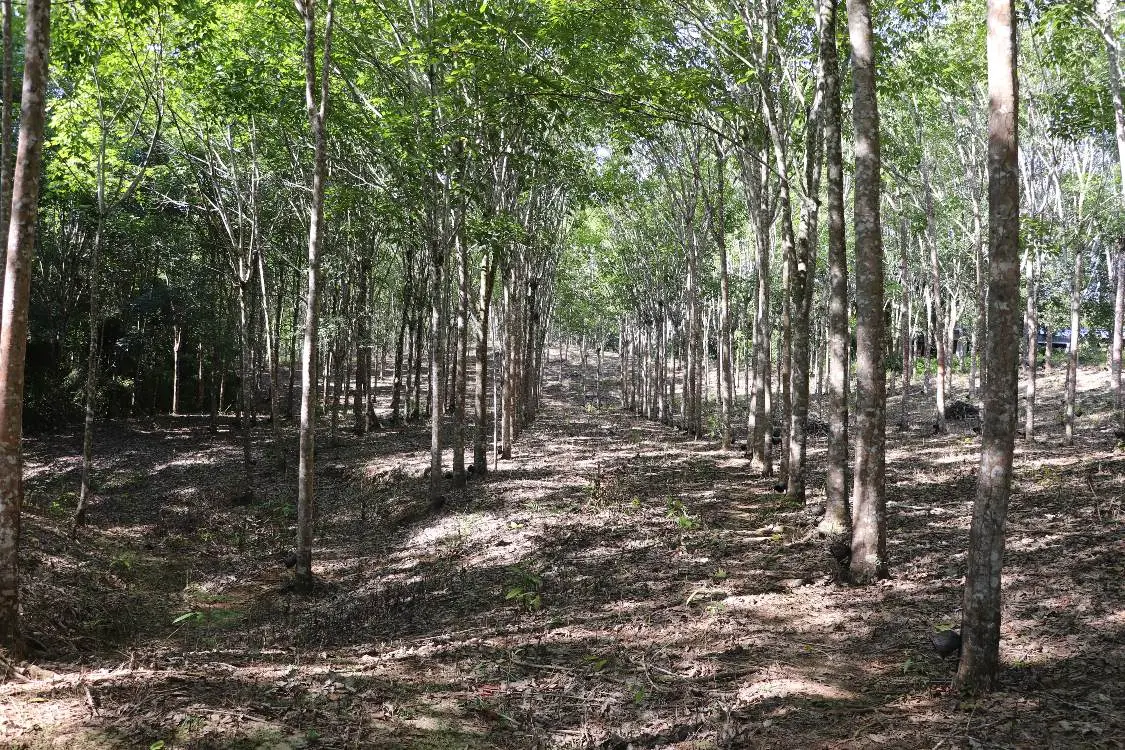
- Seeking to facilitate the social appropriation of knowledge, AGROSAVIA developed the Engagement Plan for Technological Strengthening and Sustainable Development of the Forestry Production Sector: Rubber in Colombia.
- The stimulation technique for rubber trees that helps preserve latex quality, the biopesticide Erytec, and the Web-based Geographic Information System Rubber V1.0 are part of the research results and technological offerings promoted by the Corporation to drive the productive transformation of natural rubber cultivation in Colombia.
- The research and technology transfer teams will continue coordinating efforts with regional stakeholders to consolidate a modern, resilient, and sustainable production system that strengthens the competitiveness of Colombian rubber and improves producers’ well-being.
San Roque, Antioquia. November 27, 2025. Aiming to increase productivity and improve the economic and social sustainability of natural rubber producers in the country, Corporación colombiana de investigación agropecuaria (AGROSAVIA), through the Engagement Plan for Technological Strengthening and Sustainable Development of the Forestry Production Sector: Rubber in Colombia, carried out various training and technology transfer activities to promote the dissemination and adoption of the corporate technological offerings available for this production system.
This initiative was carried out with the support of the technical teams from the El Nus, La Libertad, and Turipaná Research Centers, enabling the sharing of information, technical recommendations, and support for producers, technical assistants, extension agents, and other actors in the rubber production chain in regions of the country prioritized for their planted areas, production volumes, and number of producers: Bajo Cauca in Antioquia, southern Córdoba, and Orinoquía.
Among the main limitations identified in these areas are low productivity (less than 100 mL/tree/tapping), shortages of specialized tapping labor, pest damage, limited information for plantation management, lack of knowledge about the physiological status of the crops, and competition with other local economies, such as mining in some regions.
Seeking to facilitate the social appropriation of knowledge, AGROSAVIA carried out participatory activities, workshops, field days, and knowledge and experience exchange sessions with the various stakeholders involved. These spaces served to disseminate the following research results and technological offerings as a contribution to the productive transformation of natural rubber cultivation in Colombia:
Technique for stimulating rubber trees while preserving latex quality: This protocol outlines the technique, precautions, and benefits associated with stimulating rubber trees. Its implementation in Bajo Cauca (Antioquia) and southern Córdoba extends the latex flow, increases production, and reduces tapping frequency (every four days instead of every two or three, as is typically done). This enables more efficient labor management and reduced production costs. To date, more than 70 people have been trained in Bajo Cauca, northeastern Antioquia, and southern Córdoba.
Erytec biopesticide: This is a biological alternative for controlling the hornworm (Erinnyis ello) in rubber and cassava crops. This bioinput is developed from a granulovirus isolate and formulated as a wettable powder; it is compatible with other agrochemicals and has an 80% efficacy rate in controlling the hornworm, reducing losses caused by this pest by 30–50%. A total of 106 producers have received training in its use in Bajo Cauca (Antioquia), Córdoba, and Orinoquía.
Web-based Geographic Information System Rubber V1.0: This national geospatial tool supports productive planning by enabling informed decision-making for selecting areas with suitable soil, climate, and sanitary conditions for establishing commercial rubber plantations. It facilitates the identification of optimal cultivation areas based on each species’ specific requirements. Knowledge, management, and use of this system were the central themes of workshops and virtual seminars attended by more than 250 participants nationwide.
These technologies have been presented on production farms, at regional offices, in training settings such as SENA, and in virtual seminars.
Results and projections
The Engagement Plan strategy has consolidated significant progress thanks to the coordination achieved in the territories with rural communities and institutions aligned with our corporate mission. Technical assistance sessions were conducted in the municipalities of Montelíbano and Puerto Libertador (Córdoba), Caucasia (Antioquia), Puerto López (Meta), and at our Research Centers La Libertad in Villavicencio (Meta) and El Nus in San Roque (Antioquia), among other community intervention settings.
As a complement and part of the outreach component, AGROSAVIA also provides access to the Productive Model for Natural Rubber (Hevea brasiliensis) Cultivation in Bajo Cauca (Antioquia) and Southern Córdoba. This publication aims to serve as a reference tool based on a territorial approach, offering information that facilitates decision-making and investment prioritization for producers.
This productive model and its contents can be consulted at https://editorial.agrosavia.co/index.php/publicaciones/catalog/book/304.
In the eleven chapters that compose this text, specific topics are addressed with the aim of providing producers with sufficient information to improve the sustainability of their farms. These include analyses of environmental conditions in the target area, phenological characteristics of the species, propagation systems and nursery management, soil and climate requirements, planting systems, cultural practices, integrated pest and disease management, latex characteristics, and particularities of the rubber production chain in the study areas.
From the regions, the research and technology transfer teams assigned to the Permanent Crops Innovation Network will continue coordinating efforts with regional stakeholders to consolidate a modern, resilient, and sustainable production system that strengthens Colombian rubber competitiveness and improves producers’ well-being.
- More information here:
- Nilsen Sánchez Garzón
- Communications, Identity and Corporate Relations Professional
- Research Center La Selva - El Nus
- Communications, Identity and Corporate Relations Advisory Office
- nasanchez@agrosavia.co
- AGROSAVIA