


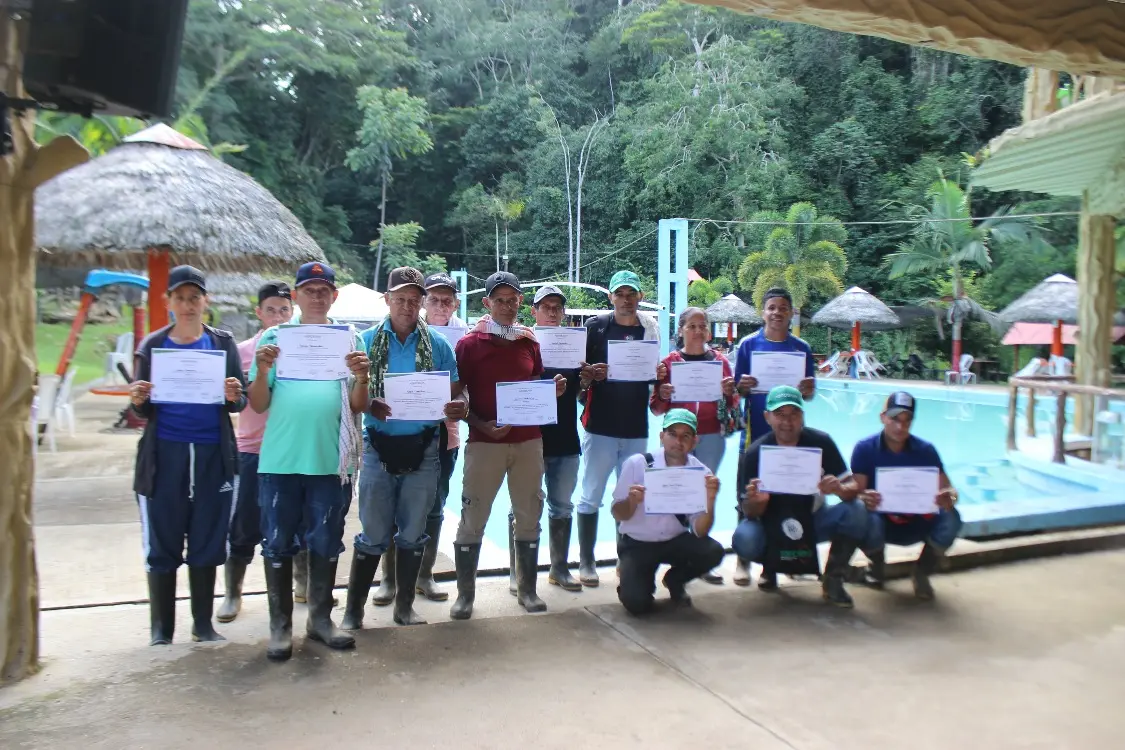
- The Vegachí Cocoa Growers Association (ASOCAOVE) successfully established and consolidated a clonal garden and obtained ICA registration as a plant material producer.
- The research team at AGROSAVIA’s El Nus Research Center strengthened ASOCAOVE’s technical, organizational, and productive capacities, promoting the production of high-quality plant material and its formalization as a producer of selected cacao seed.
- Thanks to the National Seed Plan, the cocoa value chain in Antioquia, through ASOCAOVE, is expanding the supply of genetic material with high genetic, physiological, and sanitary quality for the productive scaling of cocoa in the department.
San Roque, Antioquia. May 8, 2026. Corporación colombiana de investigación agropecuaria – AGROSAVIA, through the capacities of the El Nus Research Center and as part of the activities of the National Seed Plan (PNS), advanced in the consolidation of cacao seed production nuclei with genetic, physiological, and sanitary quality in the department of Antioquia.
Between 2023 and 2025, the cocoa research team at the El Nus Research Center carried out a support process to strengthen the technical, organizational, and productive capacities of members of the Vegachí Cocoa Growers Association (ASOCAOVE). This work enabled the organization to secure plant material for scaling up production and establishing a clonal garden, thereby advancing its formalization as a producer of selected cacao seed.
A clonal garden or clonal orchard is an area planted with plants derived from the vegetative propagation (grafts or buds) of previously selected elite trees. In other words, all plants are genetic copies (clones) of trees with superior characteristics that have already demonstrated high yields and superior quality.
In cacao cultivation, a clonal orchard is made up of trees selected for traits such as high productivity, good bean quality, tolerance or resistance to diseases (such as frosty pod rot or witches’ broom disease), and strong agronomic performance, among others. These trees may serve various commercial purposes, such as the production of dry cocoa beans, while their primary purpose is to produce plant material (budwood or bud-bearing shoots) used for grafting new plants.
During the project implementation period, jointly agreed work plans were formulated, the technical team was coordinated, and interventions were aligned with strategic partners. In the field, monitoring activities were carried out on the association’s plot where the trees comprising the clonal orchard were established. Demonstration practices in grafting and plant material management were conducted, and training sessions were implemented on traceability, nutrition, agronomic management, and phytosanitary control of pests and diseases of economic importance for this production system.
One of the main achievements was the consolidation of ASOCAOVE’s clonal orchard, which was adapted in accordance with the technical and documentary requirements established by the Colombian Agricultural Institute (ICA, for its Spanish acronym), in compliance with Resolution No. 0780006 of 2020. In the final phase, with the support of Compañía Nacional de Chocolates (CNCh), preparations for ICA’s technical inspection were strengthened, and the documentation required for the registration of ASOCAOVE’s clonal orchard as a producer of plant material was formally submitted.
Technical monitoring allowed validating the proper agronomic field development of cacao clones such as TCS 19, TCS 06, FCHI 8, FEAR 5, CNCh 12, CNCh 13, CCN 51, and materials for sexual seed production, including CAU 37, CAU 39, and IMC 67, as well as progress in land preparation, clonal identification to ensure traceability, and the required documentation. At the same time, organizational management was strengthened through the development of the clonal orchard cost matrix and coordination with strategic partners that ensure economic sustainability and self-sufficiency in plant material.
As a result, local capacities were strengthened in grafting, nutrition, agronomic management, phytosanitary management, and post-harvest practices, in addition to training on ICA regulations for the production of high-quality plant material for self-consumption or the commercialization of selected cacao seed. These actions strengthen the autonomy of producer organizations, support compliance with national regulations, and advance the sustainable development of the cocoa production chain in Northeastern Antioquia and throughout the country.
Thanks to the National Seed Plan, the cocoa value chain in Antioquia, through ASOCAOVE, is expanding the supply of genetic material with genetic, physiological, and sanitary quality for the productive scaling of cocoa in the department.
Likewise, these efforts are aligned with the principles of the Comprehensive Rural Reform by promoting territorial rootedness, productive inclusion, the reduction of rural gaps, and the development of local capacities that improve the living conditions of rural families. In this way, more competitive, sustainable, and resilient associative models are consolidated, with greater opportunities to access specialized markets and to build fairer, more equitable rural economies.
- More information here:
- Nilsen Sánchez Garzón
- Communications, Identity and Corporate Relations Professional
- Center for Research and Technology Transfer La Selva - El Nus
- Communications, Identity and Corporate Relations Advisory Office
- nasanchez@agrosavia.co
- AGROSAVIA