


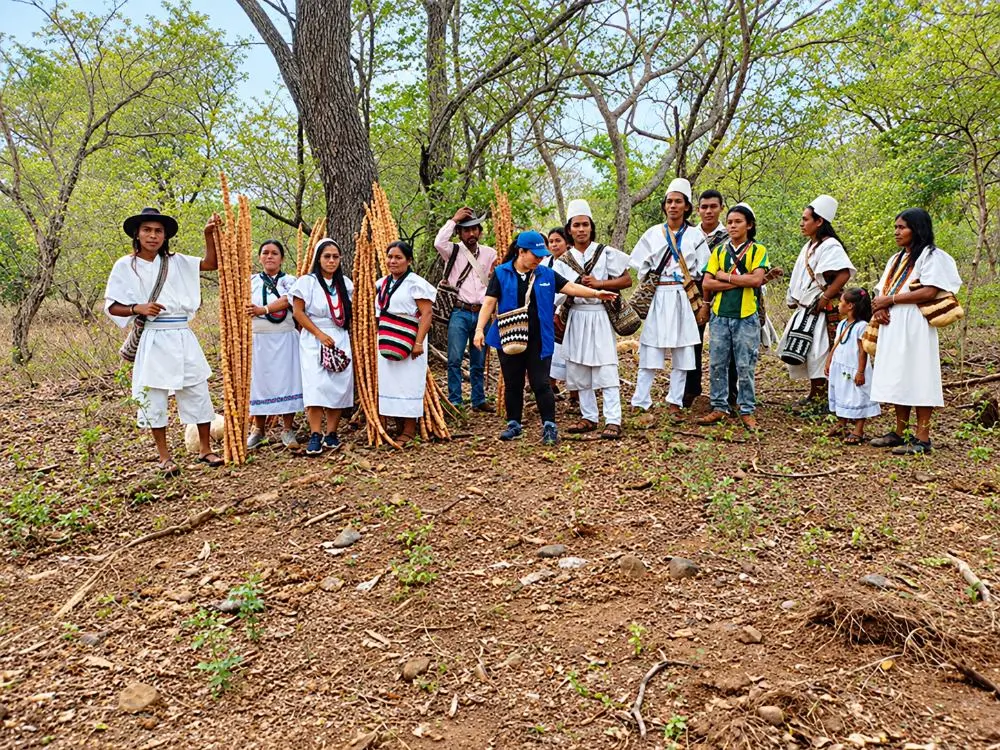
- Joint efforts have advanced the registration of five new cassava cultivars for Colombia, featuring characteristics that address the production needs of local territories and the agribusiness sector. In addition, one elite genotype identified as promising for the Colombian Caribbean region is a yellow cassava clone that producers in Catatumbo are already beginning to use to make snacks. These activities are part of the process of evaluating early producers' acceptance before registration with the Colombian Agricultural Institute (ICA).
Valledupar, Cesar. October 9, 2026. In Colombia, agricultural research and innovation are advancing to develop plant materials suited to local conditions and capable of creating new opportunities for producers. To this end, AGROSAVIA—Corporación colombiana de investigación agropecuaria—and the International Center for Tropical Agriculture (CIAT) are strengthening their joint efforts to contribute to the development of new cassava varieties with production and agro-industrial potential.
This collaboration is being carried out under the project "Competitive, Sustainable Cassava Production System with a Territorial Development Approach," corresponding to Project 87052 under MinCiencias Call 903 and coordinated by the Universidad del Cauca. As part of this process, AGROSAVIA established a memorandum of understanding with CIAT to advance the registration of five new cassava cultivars for Colombia, resulting from the Cassava Bioeconomy Project.
The work carried out, which is currently in the project closeout phase, included the evaluation of genetic materials derived from breeding programs to identify those with favorable characteristics for producers and the potential to meet the production and agroclimatic conditions of different regions of the country.
Research that Addresses Territorial Needs
According to Sandra Salazar, a cassava breeder at CIAT's Cassava Breeding Program, "CIAT is responsible for selecting the best parental lines, conducting crosses, and identifying segregating populations that address the specific needs of Colombia and other cassava-growing regions worldwide. Based on selection indices, priority is given to the populations that are delivered to AGROSAVIA."
Similarly, Researcher Adriana Tofiño, from AGROSAVIA's Motilonia Research and Technology Transfer Center, explains that "the Corporation plays a fundamental role in the selection process, the participatory evaluation of these materials with producers and industry stakeholders, and the implementation of agronomic trials and characterization studies required by ICA for their registration as new cultivars for specific subregions."
Under Project One of the Cassava Bioeconomy Program, progress has been made toward registering one variety for the starch industry in the Caribbean coastal region, Almidona 28. Registration efforts are also underway for two varieties for the Pacific subregion and two for the Inter-Andean Valleys subregion (the geographic valley of the Cauca River).
Additionally, the promising genotype GM 3426-5 was identified. This yellow cassava has shown characteristics of interest for both consumption and agro-industrial processing, particularly in the Caribbean region and other territories where producers and organizations are already exploring alternatives to add value to this raw material.
The material exhibits good root development, high fresh-root yield, a dry matter content suitable for agro-industrial processing, and other processing-favorable characteristics, including its carotenoid content. These attributes create opportunities to strengthen Colombia's cassava value chain.
From the Field to Snacks
The potential of this material is already beginning to translate into productive initiatives. In Catatumbo, producers affiliated with the Association of Agricultural and Agro-industrial Producers of Catatumbo have made progress in processing this yellow cassava to produce snacks.
For Miguel Ángel Vaca, a producer from Catatumbo, this experience represents an opportunity to demonstrate that agro-industrial processing can contribute to regional development. "We are proud to have established a partnership with AGROSAVIA, which has provided the support we needed to reach the point where we can now showcase cassava snacks like the ones we have developed. We want to make the most of this variety and bring it to market through agro-industry."
Beyond its production characteristics, the root's natural yellow color is a distinguishing attribute for processed products, as it allows producers to develop foods with an appealing appearance without adding colorants to achieve this characteristic.
For Catatumbo's producers, this experience also carries significance beyond the processing of an agricultural product. Creating production and agro-industrial alternatives represents a commitment to the region and to new economic opportunities for rural families in an area historically affected by various social challenges.
AGROSAVIA and CIAT aim to continue evaluating materials that can diversify the range of cassava varieties available in Colombia, strengthen productivity, and create alternatives for adding value to this nationally important crop.
- More information here:
- Ronal Rosado Peinado
- Communications, Identity and Corporate Relations Professional
- Center for Research and Technology Transfer Motilonia
- Communications, Identity and Corporate Relations Advisory Office
- rrosado@agrosavia.co
- AGROSAVIA