

- Through the “Journey to the Seed” workshop, researchers and traditional knowledge holders brought together technical and ancestral knowledge to strengthen local conservation capacities and advance the development of mechanisms that facilitate community access to the Germplasm Bank for Food and Agriculture.
Santiago, Putumayo. August 31, 2026. The research team from Corporación colombiana de investigación agropecuaria (AGROSAVIA) returned to the municipality of Santiago, Putumayo, to reconnect with the Inga Indigenous community and continue the work developed within the framework of Goal 15, an initiative aimed at identifying, together with different communities across the country, the factors that may facilitate their access to the genetic resources conserved in the Germplasm Bank for Food and Agriculture.
This visit is part of a participatory process led by AGROSAVIA in collaboration with three rural communities in Colombia. Its purpose is to jointly develop tools, guidelines, and inputs adapted to the dynamics and needs of each territory, contributing to more effective, sustainable, and relevant access to the genetic resources conserved in the Bank.
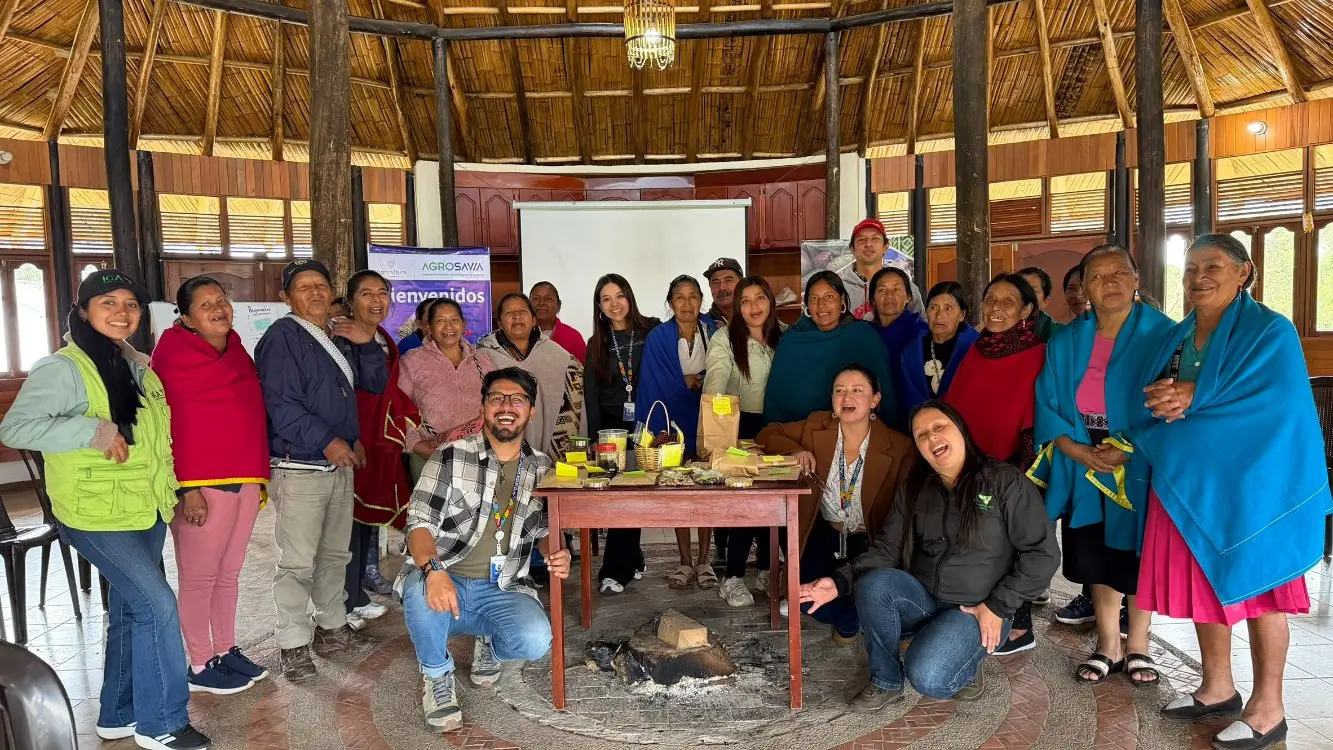
The meeting took place at the Maloca of the Inga Indigenous Council, a space for gathering, dialogue, and knowledge transmission within the community. There, the in-person “Journey to the Seed” workshop was conducted, a pedagogical strategy that is part of the toolkit of AGROSAVIA’s Integrated Agrobiodiversity Conservation Program.
“The purpose of the ‘Journey to the Seed’ workshop is to foster dialogue between two knowledge systems: Indigenous traditional knowledge and technical knowledge. Through this exchange, we seek to strengthen local capacities for the conservation, management, and use of seeds, recognizing the fundamental role of community seed houses,” highlighted members of the research team.
During the session, researchers, traditional knowledge holders, and community members exchanged knowledge on fundamental aspects of seed physiology, anatomy, and biology. This dialogue enabled the team to collectively assess the condition of the native seeds conserved by the community and identify opportunities to strengthen management, conservation, and storage practices in community seed and agrobiodiversity houses.
The exercise also made it possible to continue identifying, from the perspective of the Inga community, the needs, capacities, and conditions that should be considered to facilitate the relationship between community-based conservation systems and the Germplasm Bank for Food and Agriculture.
Through these spaces for joint knowledge-building in the territories, AGROSAVIA is advancing its goal of bringing the Germplasm Bank closer to communities and strengthening the connection between in situ and ex situ conservation, while recognizing the local knowledge, practices, and systems that have historically contributed to conserving the country’s agrobiodiversity.
This process seeks to ensure that conserved genetic resources not only remain available in the collections, but can also be known, used, and leveraged by communities, contributing to the conservation, sustainable use, and appreciation of agrobiodiversity in the territories.
- More information here:
- Mónica Milena Burbano
- Communications, Identity and Corporate Relations Professional
- Center for Research and Technology Transfer Obonuco - El Mira
- Communications, Identity and Corporate Relations Advisory Office
- mmburbano@agrosavia.co
- AGROSAVIA