


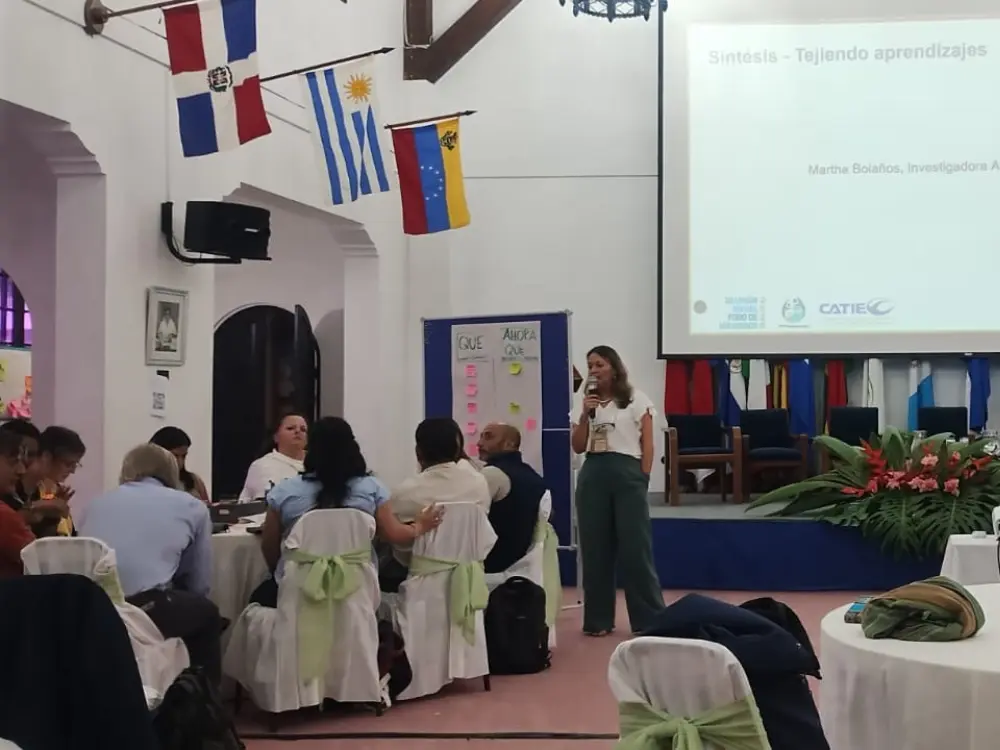
Mosquera, Cundinamarca. May 20, 2026. Corporación colombiana de investigación agropecuaria (AGROSAVIA) participated in the 2026 annual TPP-Agroecology Members Forum, held from May 12 to 15 at the campus of the Tropical Agricultural Research and Higher Education Center (CATIE) in Turrialba, Costa Rica.
The event was organized by the Transformative Partnership Platform on Agroecological Approaches to Strengthen Livelihood Resilience and Landscapes (TPP-Agroecology) and CATIE, bringing together experts from research institutions, academia, social organizations, public entities, and stakeholders linked to science, technology, innovation, public policy, and rural development, both in person and virtually.
TPP-Agroecology promotes the transition toward more sustainable agricultural and food systems by articulating stakeholders and institutions working in agroecology across different scales, contexts, and territories. This approach recognizes the importance of integrating local and scientific knowledge, as well as understanding the interactions among plants, animals, people, and the environment, to contribute to the sustainable transformation of food systems and strengthen territorial food and nutrition security.
The annual TPP-Agroecology meeting serves as a global platform for exchanging experiences and sharing research advances in agroecology. In this edition, discussions focused on advancing key thematic issues for agroecology in Latin America and identifying opportunities to strengthen TPP’s connections with regional networks, key stakeholders, and initiatives across the region.
During the May 14 session, the academic agenda focused on analyzing how the social, productive, and institutional characteristics of territories influence agroecological transition strategies at different scales, from the farm level to the landscape level. The discussion addressed methodological tools linked to public policy frameworks, knowledge management, and participation, as well as the role of key stakeholders and institutional coordination mechanisms in strengthening territorial governance across different agroecological transition experiences.
Representing AGROSAVIA, senior Ph.D. Researcher Martha Marina Bolaños Benavides, Head of the Sustainable Intensive Production Department (DPIS) within the Research and Development Directorate, delivered the presentation “Agroecological Territories: Toward the Scaling of Food Systems for the Future.” Developed collaboratively with the DPIS team, the presentation compiled international, Latin American, and Colombian experiences demonstrating how agroecological territories are shaped through the integration of local and scientific knowledge, productive diversification, socioecological resilience, community organization, short supply chains, territorial governance, and public policies oriented toward sustainable food systems.
The presentation emphasized that agroecological transition does not depend solely on isolated productive practices, but rather on long-term territorial processes that connect producers, communities, institutions, research, education, local markets, and public policies. Within this framework, the importance of implementing agroecological performance assessment tools, together with participatory learning methodologies, was highlighted as a key mechanism for diagnosing, co-designing, and strengthening transition processes within territories.
In this context, two key initiatives implemented by AGROSAVIA in Colombia that integrate this approach were presented: the National Agroecology Plan in Prioritized Peasant Territories (PLANA), funded by the Ministry of Agriculture and Rural Development (MADR), and the Colombian-German Agroecological Project (PACA), an international cooperation initiative between MADR and the German Federal Ministry of Food and Agriculture.
From this perspective, AGROSAVIA’s participation enabled showcasing its progress in developing agroecological approaches and the role of applied research in supporting innovation processes, social inclusion in technological development, and territorial scaling.
Associate MSc Researcher Leidy Tibaduiza Castañeda presented the “Weaving Impact” methodology and its application in a case study linked to her doctoral thesis entitled “Knowledge and Agricultural Research: An Analysis of Knowledge Systems in Sugarcane Production and Musaceae Conservation within Agroecological Transition Contexts.” In her presentation, she explained that this methodology, jointly developed by AGROSAVIA and CIRAD, enables the ex ante impact assessment of research and development projects in the agricultural sector. It also incorporates a transdisciplinary approach that promotes knowledge dialogue and the collective construction of knowledge, guiding both project formulation and evaluation from an impact-oriented perspective.
Throughout the event, the researchers participated in various working groups and field visits, which enriched their experience in Costa Rica. Through interactions with small-scale producers, they learned how sociopolitical crises and changing contexts have strengthened the emphasis on food production and how agroecology is increasingly positioned as an alternative for preserving peasant culture, family health, and territorial integrity.
AGROSAVIA’s participation in this international forum reaffirms the institution’s commitment to generating scientifically, technologically, and territorially relevant knowledge for the sustainable transformation of agri-food systems. It also strengthens the Corporation’s articulation with global agroecology networks, research-for-development initiatives, international cooperation efforts, and capacity-building processes for the future of the Colombian agricultural sector.
Finally, these international spaces, where initiatives and experiences from different continents are shared, allow highlighting strategic institutional approaches and advance the consolidation of sustainable agricultural production through approaches such as agroecology, with an emphasis on peasant, family, ethnic, and community agricultural systems.
- More information here:
- Ivan David Alba Hidalgo
- Communications, Identity and Corporate Relations Professional
- Headquarters
- Communications, Identity and Corporate Relations Advisory Office
- ialba@agrosavia.co
- AGROSAVIA