


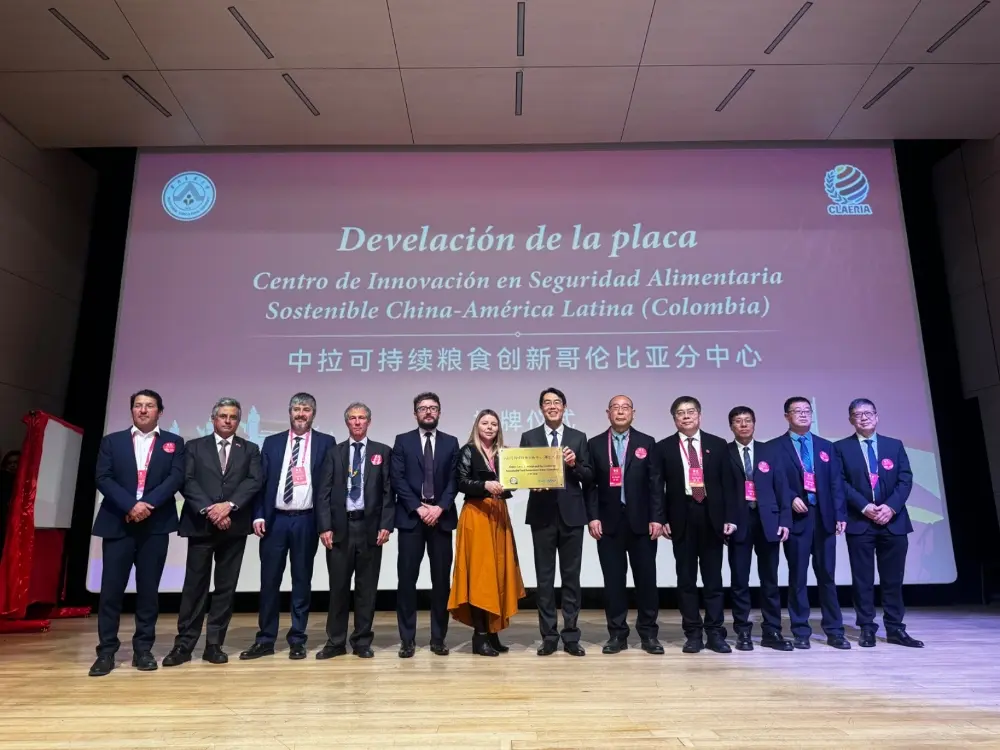
Bogotá, Capital District. May 21, 2026. Colombia took a strategic step to strengthen international scientific cooperation for the future of agriculture by launching the China–Latin America and the Caribbean Center for Sustainable Food Innovation (CLAC-SFIC) – Colombia Subcenter, an initiative led by Colombia’s Ministry of Agriculture and Rural Development through AGROSAVIA and the Yazhouwan National Laboratory. The initiative reinforces collaboration between Asia and Latin America in agricultural research, technological innovation, and sustainable food security.
The inauguration ceremony took place in Bogotá, after which the delegation traveled to AGROSAVIA’s Tibaitatá Research Center, where a space within the partnership was also allocated to the delegation for use during their operations in Colombia. Representatives of the national government and scientific delegations from both countries gathered there to formalize the launch of a long-term cooperation platform for the joint development of scientific and technological capacities.
The inauguration of the CLAC-SFIC Colombia Subcenter represents international recognition of AGROSAVIA’s scientific capabilities and its role as an institution that connects global agri-food research networks. The official ceremony included the opening of the Latin American Center of the South China Agricultural University and the unveiling of the commemorative plaque for the new cooperation center, symbolizing an alliance that will accelerate research in genetic breeding, sustainable agriculture, biotechnology, plant health, and the digital transformation of agriculture, with an impact on Colombia, Latin America, and the Caribbean.
The China–Colombia scientific mission also carried out a technical and strategic exchange agenda among researchers and scientific institutions from both countries, including CIAT. During the visits to the Palmira Research Center in Valle del Cauca, La Libertad Research Center in Meta, and Tibaitatá Research Center in Cundinamarca, the Chinese delegation learned about Colombian advances in the conservation of genetic resources, sustainable crop management, soybean breeding, plant health, and technologies applied to bananas and plantains, cocoa, avocado, and citrus crops—areas considered priorities for global food sustainability and for adapting agriculture to climate change.
The scope of the cooperation project includes developing shared scientific capacities, joint research initiatives, training human talent, and creating innovation platforms focused on strategic crops such as soybean, rice, maize, and tropical species. Likewise, the academic agenda facilitated the exchange of cutting-edge experiences in bio-breeding, plant immunity, digital agriculture, and resilient production systems, consolidating a shared vision between China and Latin America to promote globally relevant scientific solutions through international cooperation and the application of knowledge to the sustainable development of the agri-food sector.
- More information here:
- Ivan David Alba Hidalgo
- Communications, Identity and Corporate Relations Professional
- Headquarters
- Communications, Identity and Corporate Relations Advisory Office
- ialba@agrosavia.co
- AGROSAVIA