


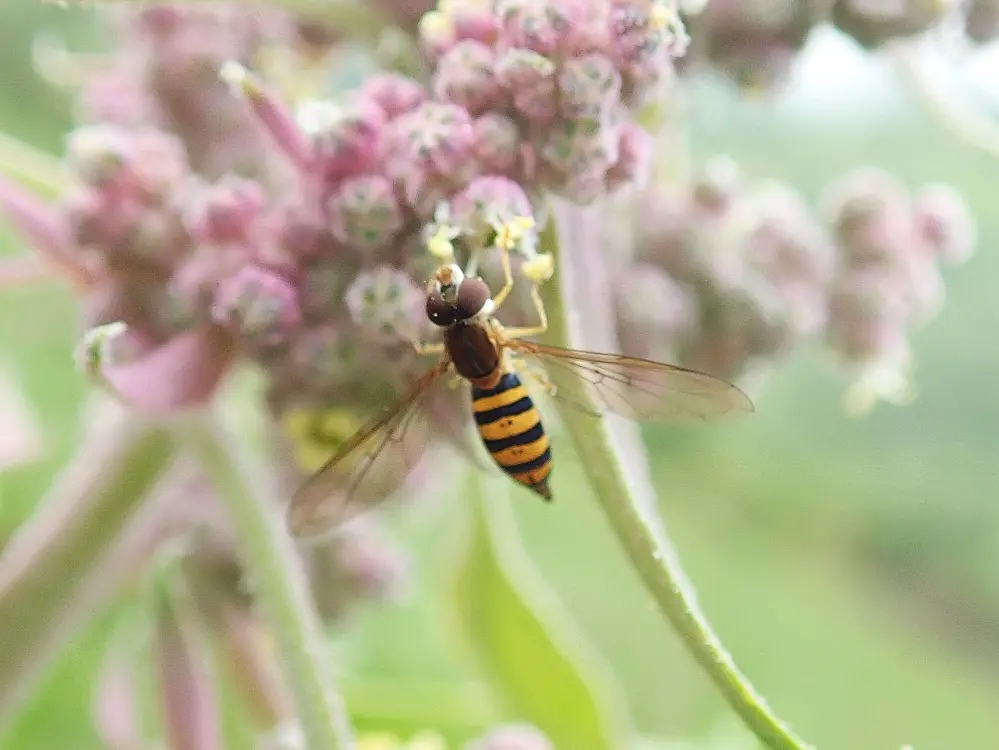
- Researchers from AGROSAVIA, in collaboration with scientists from Ecuador and Canada, published a review on the role of dipterans in pollinating crops in the Neotropics in the prestigious journal Entomologia Experimentalis et Applicata.
- Midges, flies, and mosquitoes are dipterans that contribute to pollination, a role performed by these insects that is little recognized in economically important crops.
- Understanding these insects’ role in pollination matters amid challenges such as climate change, landscape transformation, and biodiversity loss.
Palmira, Valle del Cauca. September 22, 2026. When pollination is discussed, bees usually take center stage. However, there is a little-recognized group of insects that also visits flowers, transports pollen, and contributes to food production: dipterans, two-winged insects that include flies and those commonly known as mosquitoes or midges.
A new study published in “Entomologia Experimentalis et Applicata,” an international scientific journal specializing in entomology, indexed in Web of Science (SCIE) and Scopus and ranked in Q2 in the categories of Insect Science and Ecology, Evolution, Behavior and Systematics, compiles and analyzes the available knowledge on these crop-pollinating dipterans in the Neotropical region.
The study was conducted by researchers from Corporación colombiana de investigación agropecuaria – AGROSAVIA, in collaboration with scientists from Ecuador and Canada, who highlighted the importance of these insects for pollination and underscore the lack of knowledge regarding their contribution to agricultural systems.
Dipterans constitute one of the most diverse groups of insects on the planet, and their role in pollination has received less attention than that of bees. However, the scientific evidence compiled in this review suggests that their contribution is highly important to tropical and subtropical ecosystems. For example, the study highlights the participation of these insects in the pollination of economically important production systems such as avocado, cacao, citrus, coffee, and mango, as well as other crops relevant to agriculture in the region.
In the case of cacao, midges known as biting midges, dipterans belonging to the family Ceratopogonidae, are its main pollinators because they show greater activity on the tiny flowers of this crop, come into contact with the reproductive structures more frequently, and transport significantly more pollen than bees and other floral visitors.
“Among the dipteran families that stand out for their role as pollinators are Syrphidae (flower flies), Calliphoridae (blow flies), Ceratopogonidae (biting midges), and Drosophilidae (fruit flies). These groups include species with different behaviors, ecological characteristics, and associations with plants, demonstrating the diversity of mechanisms through which they can contribute to pollination,” explained Takumasa Kondo, Ph.D., Senior Researcher at AGROSAVIA’s Palmira Research and Technology Transfer Center.
A Diverse and Little-Known Group
Diptera is a highly diverse insect order, comprising more than 162,000 described species across 157 families worldwide. Of these, more than 86 families have been reported to visit flowers, of which 33 families include species that are pollinators or for which there is some evidence of their role in assisting pollination. Despite the available evidence, the study revealed information gaps, as these pollinating dipterans remain poorly studied in Central America, South America, and the Caribbean and, in many cases, insect identification does not reach a sufficient taxonomic resolution to accurately determine which species are involved in pollination.
Few experimental studies also establish how efficient these insects are compared with other pollinators and what their contribution is to crop yield and quality. “This lack of information represents an opportunity for scientific research: determining which species are involved, which crops they visit, how they transport pollen, and how efficiently they transfer it can contribute to the development of more comprehensive strategies for pollinator management in agricultural systems,” emphasized Researcher Kondo.
More Knowledge for Resilient Agriculture
Understanding the role of dipterans in pollination becomes particularly relevant in the face of challenges such as climate change, landscape transformation, and biodiversity loss. Conserving a diverse pollinator community can help maintain the stability and resilience of the ecosystem services that support agricultural production.
Thus, flies, mosquitoes, and other dipterans cease to be mere occasional visitors to flowers and become protagonists in a pollination story that remains largely undiscovered across much of the Neotropics.
The study serves as a call to broaden our perspective on pollinators and to recognize that food production depends on a much more diverse community of insects than has traditionally been considered. Deepening our knowledge of these organisms will not only help us better understand the biodiversity of agroecosystems, but also to develop strategies to conserve and sustainably harness the pollination services they provide.
Reference: Kondo, T., Chirinos, D.T., Castro, R., Vega, J.G., & Skevington, J.H. (2026). Unveiling the diversity of dipteran pollinators in the Neotropical realm. Entomologia Experimentalis et Applicata, 1–18 https://doi.org/10.1111/eea.70183. [Online version].
- More information here:
- Claudia Narváez Marmolejo
- Communications, Identity and Corporate Relations Professional
- Center for Research and Technology Transfer Palmira - Popayán
- Communications, Identity and Corporate Relations Advisory Office
- cnarvaez@agrosavia.co
- AGROSAVIA