


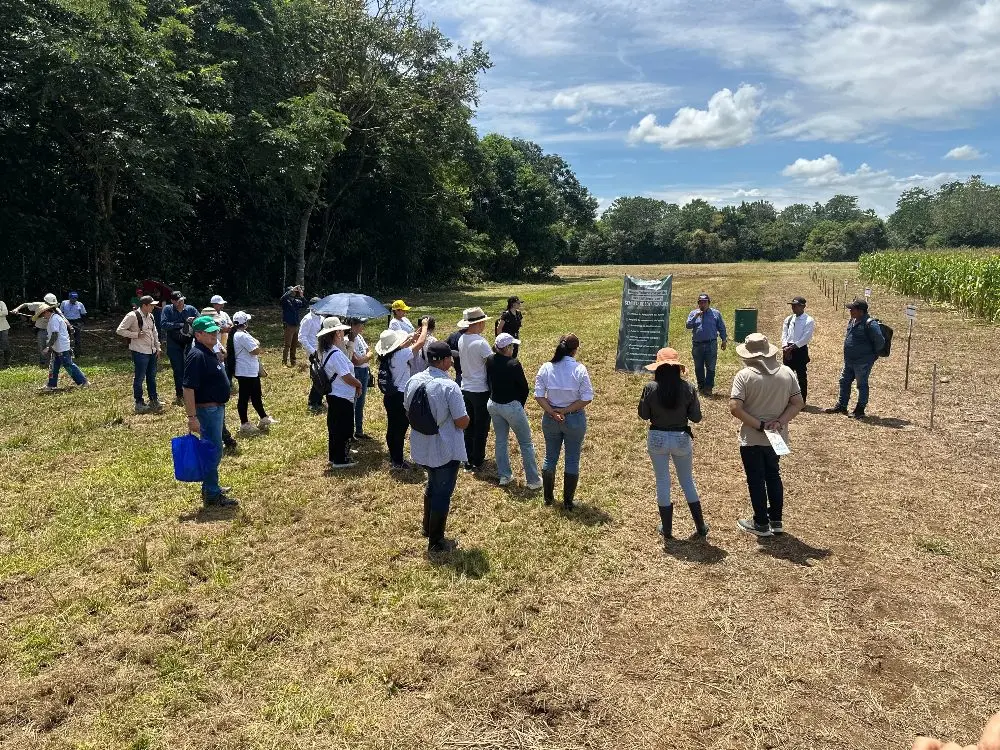
Villavicencio, Meta. August 5, 2026. As the closing activity of a technical work week in Colombia’s Altillanura region, AGROSAVIA held the Field Day – Competitiveness and Sustainability of the Maize-Soybean Production System – at the La Libertad Research and Technology Transfer Center. The event brought together researchers, producers, technical advisors, representatives of institutions, agricultural associations, and academia to learn about research advances and technologies aimed at strengthening the productivity and sustainability of this production system.
The activity was part of the project “Development and Technological Exchange to Improve the Competitiveness and Sustainability of the Maize-Soybean Production System in Colombia,” implemented by AGROSAVIA, FENALCE, and Argentina’s National Institute of Agricultural Technology (INTA, for its Spanish acronym), with the support of APC-Colombia and the Argentine Fund for International Cooperation (FOAR, for its Spanish acronym).
Throughout the week, INTA Argentina’s researchers Alejandro Saavedra and Fernando Salvagiotti, together with professionals from AGROSAVIA and FENALCE, conducted review and monitoring activities on farms in Colombia’s Altillanura region. There, they evaluated trials, exchanged experiences with farmers, and analyzed alternatives to strengthen the productivity and sustainability of maize and soybean production systems.
According to Alejandro Saavedra, an INTA researcher, this joint effort is the result of a cooperation process that began in 2018, when FENALCE visited Argentina to learn about the country’s experience with conservation agriculture. “We are not here to establish the Argentine model, but rather to share experiences and adapt technologies to the climate and soil conditions and to the reality of Colombian producers. Today, we can already see how this exchange has allowed us to develop new alternatives and strengthen joint efforts between our countries,” he stated.
The Field Day was attended by: Carmen Julio Duarte, representing FENALCE; delegates from INTA Argentina; Federico Molina, delegate of the Embassy of the Argentine Republic in Colombia; as well as representatives of APC-Colombia and FOAR, who highlighted the value of international cooperation in promoting more competitive, resilient, and sustainable agricultural systems.
During the academic session, experts from Colombia and Argentina presented experiences and research findings on maize and soybean production, the National Phytosanitary Monitoring Network (REDMAS, for its Spanish acronym), conservation agriculture, no-till farming, minimum tillage, crop rotation, and economic analysis for decision-making in production systems.
The activities were coordinated with the REDMAS project – National Phytosanitary Monitoring Network for Maize and Soybean in Colombia – funded by FENALCE. This initiative strengthens phytosanitary surveillance and the timely management of the main pests and diseases affecting these crops.
As a central component of the Field Day, participants toured the long-term trials on soybean-maize-service crop rotations and the REDMAS sentinel plots established at the La Libertad and Taluma research centers. They also learned about the progress of the FONTAGRO project related to the evaluation of bioproducts for maize production and the collaborative trials of the Transitory Crops Network conducted by AGROSAVIA.
In this context, Fernando Salvagiotti, an INTA Argentina researcher, emphasized that one of the main outcomes of the cooperation has been the establishment of long-term trials that will generate information to guide the sustainable management of production systems in the Altillanura. “The results of conservation agriculture are not observed from one year to the next; they are cumulative processes. Therefore, having long-term trials allows us to assess the effects of practices such as no-till farming, crop rotations, and the use of cover crops, generating knowledge adapted to Colombia’s conditions,” he explained.
The Field Day made it possible to bring together, in a single setting, scientific advances, collaborative trials, and the experience of researchers, producers, and technical advisors, strengthening knowledge transfer and consolidating an international cooperation network that contributes to the development of more competitive and sustainable maize and soybean production systems for the country.
Through initiatives of this kind, AGROSAVIA, FENALCE, INTA Argentina, APC-Colombia, FOAR, and FONTAGRO continue to strengthen knowledge generation and transfer to provide innovative solutions that address the challenges facing Colombian agriculture.
- More information here:
- Darlin Conrado Mosquera
- Communications, Identity and Corporate Relations Professional
- Center for Research and Technology Transfer La Libertad
- Communications, Identity and Corporate Relations Advisory Office
- dconrado@agrosavia.co
- AGROSAVIA