


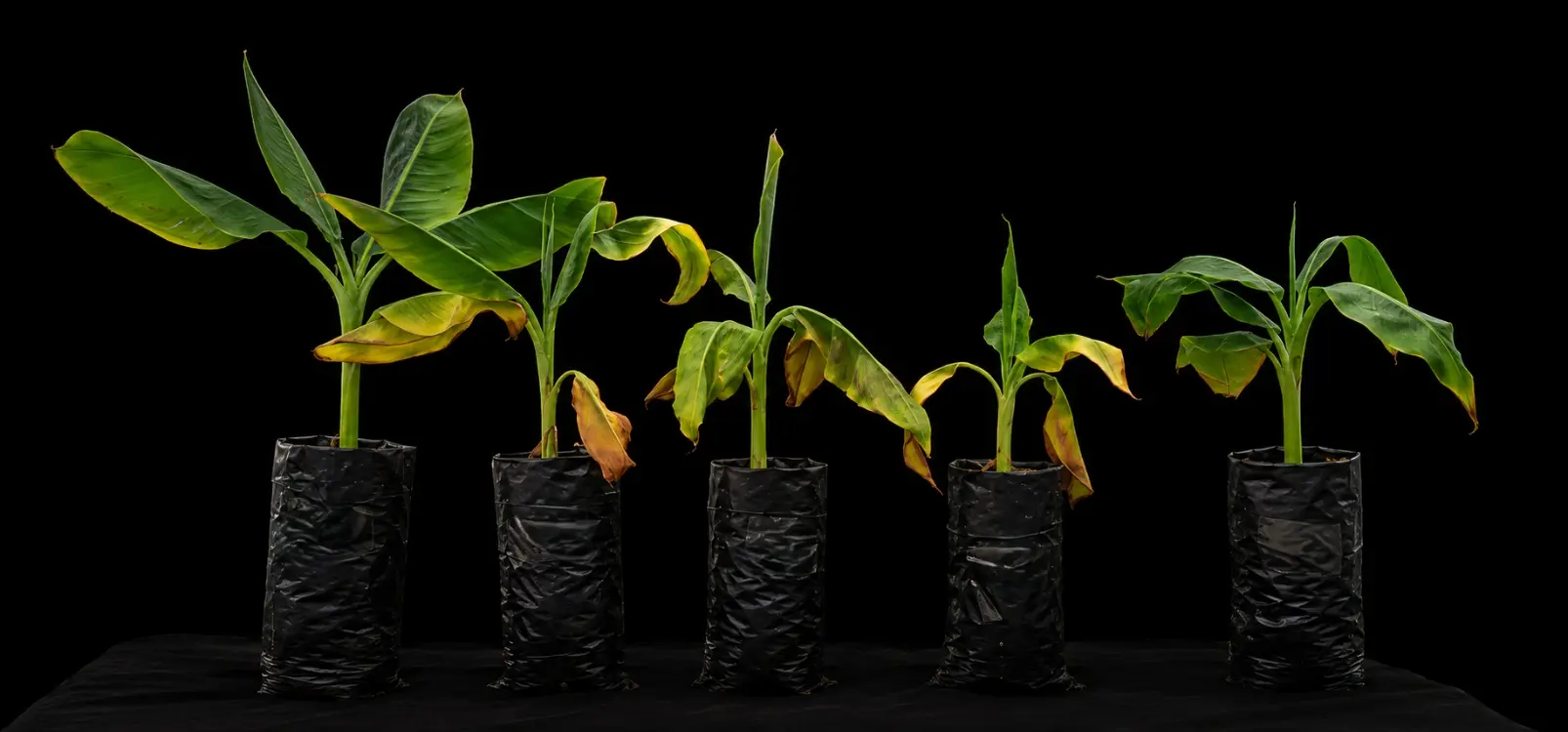
- Research conducted by AGROSAVIA under laboratory and greenhouse conditions identified microorganisms that can reduce Fusarium wilt. The finding opens a path toward exploring alternatives that could reduce the use of chemical products in banana and plantain crops, although the results still need to be validated under field conditions and on farmers’ farms.
Mosquera, Cundinamarca. September 1, 2026. Wilt caused by Fusarium progressed with lower severity in banana plants treated with lactic acid bacteria. This was the main result of a study that explored the use of beneficial microorganisms against two serious phytosanitary threats affecting musaceous crops: Fusarium and Ralstonia, the latter being the causal agent of moko disease.
Both pathogens can cause plant losses and generate economic consequences for farmers. The problem is particularly important in Colombia, where bananas hold a significant position among export fruits, while plantains are part of the daily diet of millions of households.
The study arose from the need to identify management options that reduce dependence on chemical products that may affect the environment and the health of those who apply them. Lactic acid bacteria became candidates because they had previously shown favorable results against diseases in crops such as cape gooseberry and tomato.
“We wanted to explore management alternatives using biocontrol agents. Lactic acid bacteria had shown good performance in other production systems, and we needed to determine whether they could act against the pathogens affecting bananas and plantains,” explained the research team from the Tibaitatá Research and Technology Transfer Center.
From the Germplasm Bank to the Greenhouse
The research began with a preselection of lactic acid bacteria preserved in a Microorganism Germplasm Bank. In the laboratory, researchers challenged different strains with the pathogens to identify those capable of inhibiting their growth.
The bacteria that showed inhibitory capacity moved on to a second stage: testing on banana plants under greenhouse conditions. The purpose was to determine whether the effect observed in a laboratory culture plate was maintained when the plant, the pathogen, and the potential biocontrol agent were brought together.
The results against Fusarium were encouraging. In plants treated with lactic acid bacteria, disease progression was significantly lower than in those that did not receive the treatment. This indicates that the microorganisms evaluated could become a complementary tool for managing wilt.
The finding does not yet constitute a solution available to producers. Before that, it will be necessary to establish how the bacteria behave outside the greenhouse, what dosage is required, how frequently they should be applied, and how they respond to the variable conditions found on a farm.
The Laboratory Does Not Always Predict What Happens in a Plant
The Ralstonia tests taught a different lesson. The lactic acid bacteria were able to inhibit the microorganism that causes moko disease in the laboratory, but this effect was not reproduced when they were evaluated in plants.
This difference shows why a favorable in vitro result must be verified in living organisms. In the laboratory, the direct interaction between two microorganisms can be observed; in a plant, its defense mechanisms, tissues, environmental conditions, and numerous biological interactions come into play, all of which can modify the response. “We confirmed that a biocontrol effect may exist in vitro, but the interaction changes when the plant is involved. Therefore, the trials cannot remain at the laboratory stage: they must progress to testing in plants,” the team noted.
Far from being a failed result, this response helps rule out premature conclusions and guides the search for strains that can perform under conditions more closely resembling those faced by farmers.
Research Focused on Two Key Crops
The study was conducted under the framework of the FONTAGRO Musaceae project ATN/RF-18761-RG (1002280) and Agreements 10 of 2021 and 11 of 2022 with the Colombian Agricultural Institute (ICA, for its Spanish acronym), derived from Agreement 021 of 2018.
The research focused on bananas and plantains because of their nutritional and economic importance. Diseases caused by Fusarium and Ralstonia require strict management measures and, in certain cases, the eradication of affected plants to prevent the pathogens from spreading.
The future use of bacteria with biological control capabilities could reduce some chemical applications, decrease worker exposure, and limit soil and water contamination. It could also help contain losses, provided that their effectiveness is confirmed outside the greenhouse.
The Decisive Test Will Be in the Field
The next stage includes evaluations under semi-controlled field conditions. If the results hold, the bacteria will then be tested on farmers’ properties.
This step will be decisive. On a farm, the microorganisms must function under changes in temperature, rainfall, soil characteristics, and management practices that cannot be fully reproduced in the laboratory.
The challenge now is to determine whether the reduction in disease observed in the greenhouse can be replicated at production scale. Only then will it be possible to determine whether these lactic acid bacteria can be integrated into Fusarium management and provide banana and plantain producers with an effective alternative for protecting their crops with fewer chemical products.
- More information here:
- María Elena Londoño Rubio
- Communications, Identity and Corporate Relations Professional
- Center for Research and Technology Transfer Tibaitatá
- Communications, Identity and Corporate Relations Advisory Office
- melondono@agrosavia.co
- AGROSAVIA