


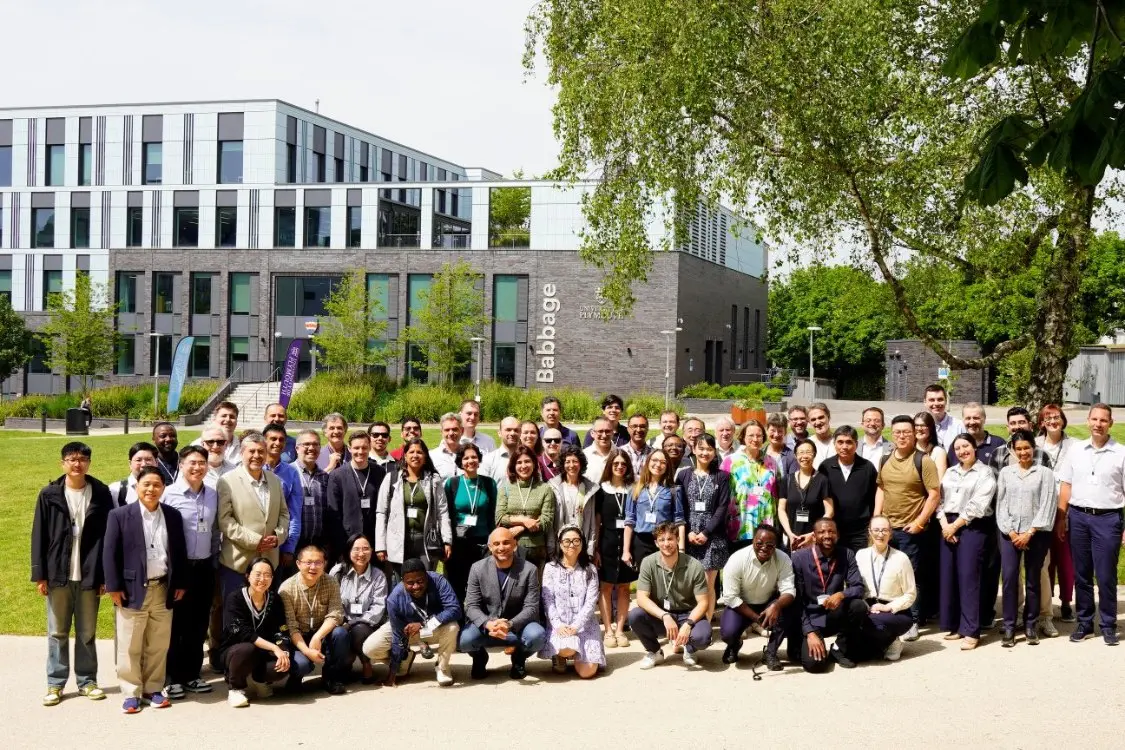
- AGROSAVIA presented scientific advances on socio-ecological resilience at an international conference that brought together experts in decision-support technologies.
Mosquera, Cundinamarca. June 10, 2026. Climate change, soil degradation, biodiversity loss, and water resource pollution are testing the capacity of agri-food systems to ensure food production. In response to this scenario, AGROSAVIA`s researchers are developing tools that enable stakeholders to anticipate, adapt to, and respond to the crises affecting agricultural systems.
During the Twelfth International Conference on Decision Support System Technology, Dr. Óscar Forero, Researcher at the Tibaitatá Research Center, delivered a keynote presentation on a decision-support system designed to address current sustainability and resilience challenges facing agri-food systems. The support system developed integrates methodologies, tools, and instruments that enable the assessment of socio-ecological resilience, facilitate the transformation of socio-technical regimes, and promote the development of relevant innovations to increase the resilience of agri-food systems.
What does it really mean for an agri-food system to be resilient? In simple terms, it refers to the capacity of communities, producers, institutions, and ecosystems to prepare for, withstand, recover from, and transform in response to unexpected crises such as droughts, floods, social conflicts, and economic disruptions. It also involves addressing ongoing incremental crises, including climate change, soil degradation, and the loss of agrobiodiversity.
“Agriculture cannot be understood solely as a productive activity. Agri-food systems are made up of people, organizations, knowledge, natural resources, and ecosystems that constantly interact. Therefore, resilience involves strengthening all of these relationships to address current and future challenges,” explained the researcher.
A methodology for strengthening territories
As a result of several years of research, AGROSAVIA developed the TISERE methodology (Socio-Ecologically Resilient Innovative Territories), a tool designed to support territories in identifying their strengths and vulnerabilities to foster local innovation processes.
The methodology combines participatory research, institutional coordination, and knowledge exchange among producers, communities, researchers, private-sector actors, and public institutions. Its objective is to promote innovations that are both environmentally appropriate and culturally relevant to each territory.
The process includes territory selection, assessing resilience indicators, and developing innovation agendas that respond to local needs.
Lessons learned through international collaboration
The conference also highlighted the outcomes of a collaboration between AGROSAVIA and Harper Adams University in the United Kingdom, focused on analyzing successful experiences in strengthening resilience within food systems affected by sudden shocks.
This work led to the development of a new conceptual framework that distinguishes four fundamental components: system attributes, system capacities, required actions, and achieved outcomes. In addition, it enabled the identification of specific actions to be implemented before, during, and after a crisis to foster learning and achieve effective transformation of agri-food systems at local, regional, and global scales.
A global challenge with territory-based solutions
The conference concluded with a call to strengthen international collaboration and joint work with communities to address the major socio-environmental challenges of the 21st century.
In a context shaped by climate change, agrobiodiversity loss, and soil degradation, resilience is emerging as a key approach for ensuring more sustainable, productive agri-food systems capable of continuing to supply food for future generations. Beyond merely resisting crises, resilience seeks to enable territories to learn from them, adapt, and identify new opportunities to build a more secure and sustainable food future.
For further details, see: Resilience of food supply systems to sudden shocks: A global review and narrative synthesis
- More information here:
- María Elena Londoño Rubio
- Communications, Identity and Corporate Relations Professional
- Center for Research and Technology Transfer Tibaitatá
- Communications, Identity and Corporate Relations Advisory Office
- melondono@agrosavia.co
- AGROSAVIA